Roof Leak Detection & Repairs — Blue Mountains
A leak that presents on the ceiling may have entered the roof from somewhere quite different — water travels along battens, rafters and sarking before dripping through. Getting it right means going on the roof, not just inside the ceiling. We locate the actual entry point, identify the cause, and fix it properly with a written scope and a fixed price. Fast response, particularly for urgent wet-weather calls.
- 🛡️ 7 Year Warranty*
- ✅ Licensed & Insured
- 📍 Local Blue Mountains Team
What's Included
- On-roof leak detection
- Photographic report
- Metal roof leak repairs
- Tile roof leak repairs
- Chimney & flashing leak repairs
- Valley leak repairs
Not sure if roof leak detection & repairs is what your roof needs?
We inspect first and tell you straight — repair, restore or replace.
Why leaks are harder to find than they look
In most cases, water enters the roof at a point that's nowhere near where it shows inside. It travels along the underside of sarking, along battens and down rafters before it finds a gap to drip through a ceiling. A 20-minute heavy rain event in Katoomba or Blackheath can drive water under poorly bedded flashings, through cracked ridge mortar, past a blocked valley, or into a lap seam on a metal roof — and the stain you see might be a metre or more away from the actual entry point. This is why leak diagnosis has to start on the roof: reading the roof surface, identifying the high-risk areas (ridges, hips, valleys, flashings, skylights, penetrations), and finding the actual break in the weatherproofing. We don't guess; we inspect.
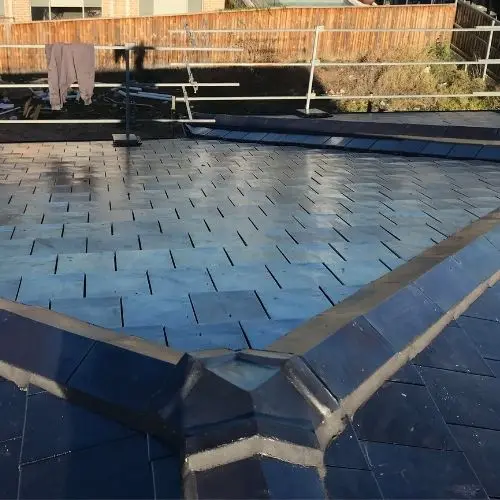
Common leak sources across Blue Mountains roofs
- Crumbling ridge cap mortar allowing water entry at the apex — very common on homes over 25 years old throughout the Mountains
- Rusted or cracked valleys backing up in heavy rain — leaf debris from eucalypt canopy is a major contributor
- Failed flashings at chimneys, parapet walls, skylights and dormer intersections
- Cracked or slipped tiles creating direct openings — often visible from the ground, but not always
- Metal roof lap seams where sealant has dried out and pulled away
- Fastener points on metal roofs where screws or nails have backed out or the neoprene washers have degraded
- Skylights with failed seals or cracked flashing aprons
When to call — urgency guide
| Symptom | Urgency | What it usually means |
|---|---|---|
| Fresh ceiling stain after a single rain event | High — call soon | Active entry point, likely to worsen in next rain |
| Brown stain on ceiling, dry to touch | Moderate — inspect this week | May be historic or may still be active — needs assessment |
| Mould or damp smell in ceiling cavity | High — call now | Ongoing moisture, possibly sarking or insulation damage |
| Water dripping through ceiling | Urgent — call immediately | Active major entry, may be affecting ceiling structure |
| Stain appearing only in heavy rain | Moderate — inspect before next event | Entry point under high hydrostatic load — common at valleys and flashings |
How the work is done
How we find and fix a roof leak
- 01
Start where the water shows
We look at the staining inside first — the shape, spread and position of a stain narrows down where water is entering and how far it is travelling.
- 02
Inspect the high-risk zones
Valleys, flashings, chimney aprons, penetrations and ridge lines account for most leaks we attend. These get checked before anything else.
- 03
Trace it systematically
Where the source isn't obvious from the roof surface, we work through the possibilities in order rather than guessing and patching.
- 04
Photograph what we find
You get photos of the actual entry point and the surrounding condition — useful for your own records and for an insurer if one is involved.
- 05
Repair or quote the scope
Small entry points are usually repaired on the spot. If the cause turns out to be larger, you get a written quote before any further work.
- 06
Confirm the repair
We re-check the repaired area before leaving, and tell you honestly if the roof has other issues likely to cause a separate leak.
What the job covers
Everything included in your roof leak detection & repairs
One fixed written quote
Every item is priced in the quote you receive after inspection — no line-item surprises once work starts.
- 01
On-roof leak detection
We inspect the full roof surface and identified high-risk zones to find the actual entry point.
- 02
Photographic report
Photos of what we find and where — useful for insurance and for your own records.
- 03
Metal roof leak repairs
Failed lap sealants, rusted panels and fastener-point leaks repaired.
- 04
Tile roof leak repairs
Cracked tiles, failed bedding, valley blockages and flashing failures repaired.
- 05
Chimney & flashing leak repairs
Chimney aprons, soakers, counter-flashings and parapet flashings repaired or replaced.
- 06
Valley leak repairs
Blocked, rusted or improperly installed valleys repaired or replaced.
- 07
Water ingress diagnosis
Where the cause isn't obvious from the roof surface, we trace water entry systematically.
Let's take a look at your roof
Free inspection, photos of what we find, and a fixed written quote for the work your roof actually needs.
Straight about price
What does it cost?
Leak detection inspection is free. Repair costs depend on the source and scope — a single tile replacement is minor; chimney flashing replacement or full valley replacement is a larger job. You'll receive a fixed written quote for the repair before we start any work. Call (02) 4742 0922.
Questions before you enquire
Roof Leak Detection & Repairs questions
Straight answers to what Blue Mountains homeowners ask us most about roof leak detection & repairs.
I've had my roof 'repaired' before and it's still leaking — why?
The most common reason is that the wrong thing was repaired. If the actual entry point wasn't correctly identified — which is genuinely difficult without getting on the roof and reading the whole surface — the repair targets a symptom, not the cause. We start every leak diagnosis from the roof, trace water paths systematically, and only quote the repair once we're confident we've found the right source.
Can you find a leak without water testing?
In most cases, yes — an experienced roofer reading a roof in daylight can identify the most likely entry points from the condition of the surface. Where the source genuinely isn't obvious, we can conduct a staged hose test to reproduce the leak under controlled conditions. We'll tell you which approach is appropriate for your situation.
How long does leak detection take?
A single-storey home typically takes 30–60 minutes to inspect thoroughly. Larger, more complex roofs with multiple pitches, chimneys and skylights take longer. We'll confirm the inspection time when we book.
Will a temporary fix hold until I can afford the full repair?
In some cases a temporary fix — a sealed patch or temporary waterproofing — can prevent further damage while you plan the full repair. However, not every situation is suitable for this: a badly rusted valley or failed flashing will keep leaking through a patch. We'll be honest about whether a temporary fix is realistic and for how long it's likely to hold.
Does a fixed-price quote include finding the leak?
The inspection is free. The repair quote is fixed: once we've identified the problem and given you a written price, that's the price for the specified scope. If we open up an area during repairs and find more damage than anticipated, we'll stop and talk to you before doing anything outside the agreed scope.
What if the leak is coming from the chimney?
Chimney-related leaks are among the trickier ones to resolve because there are multiple potential sources: the lead flashing apron, the soakers between courses, the counter-flashing above, mortar pointing on the chimney itself, or degraded cap flashing. We inspect all of these and identify the specific failure — chimney repairs without this step often fix one path and miss another.
Roof Leak Detection & Repairs across the Blue Mountains
Servicing all Blue Mountains towns and suburbs including:
Request an inspection
Ready for honest advice on your roof?
Free inspection, written fixed quote, and a straight answer — repair, restore or replace. Call (02) 4742 0922 or use the form.
GET YOUR FREE
ROOF INSPECTION & QUOTE
No obligation. Fast and reliable. 100% free.
- ✅ Fast Response
- ✅ Local Experts
- ✅ No Obligation
Prefer to talk? Call (02) 4742 0922