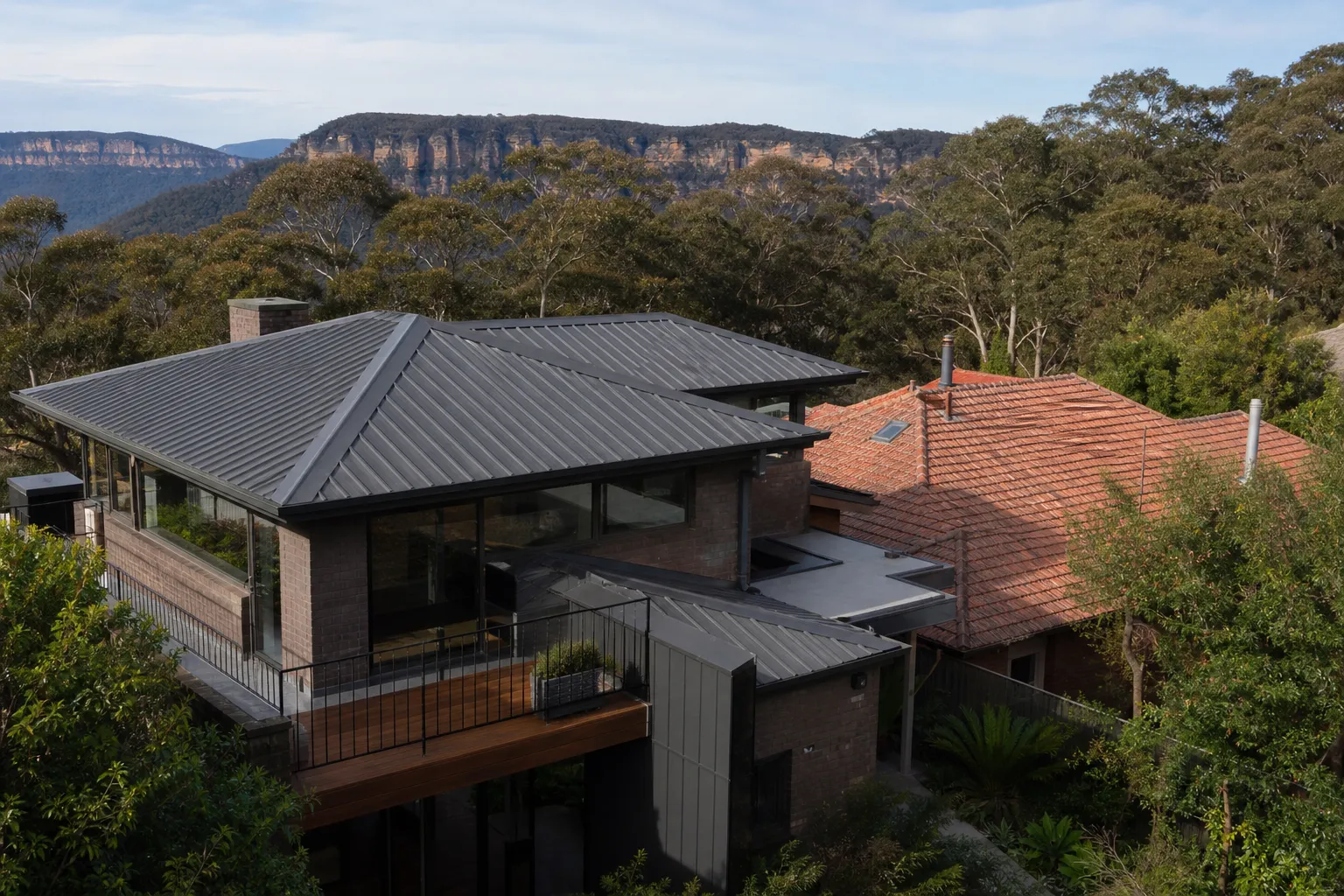
You are standing in the driveway, looking up at a tile roof that has clearly seen better days, and someone has planted the idea. Maybe it was a builder, maybe a neighbour who just did theirs, maybe the last roofer who came to quote. Have you thought about going Colorbond? It is one of the most common crossroads we reach on Blue Mountains homes. Keep the tile, or switch to metal. There is no single right answer, because the best roof depends on your house, your budget and where in the Mountains you actually live. Here is how I talk it through with homeowners, without the sales spin.
The short version
Both are good roofs. Tile, whether concrete or terracotta, is heavy, quiet in the rain, holds its own in the heat and looks right on a traditional or period home. Colorbond steel is light, quick to install, sheds water and embers well, and gives you a clean modern line. Most of the homes we look at up here already have tile, so the real question is usually narrower than "which is better". It is whether converting to metal is worth it when the old roof is due for attention anyway. For a fair few of them, the honest answer is no.
Cost: upfront and over the years
Price is where most people start, so let us be straight about it. As a rough rule, concrete tile is the cheapest covering to supply, terracotta is usually the dearest, and Colorbond steel sits somewhere in the middle on materials. The catch is labour. Switching an existing tile roof to metal is a full re-roof, so you are paying to strip the old covering and build back up, not just for the new sheets. That is a much bigger job than freshening up what you have.
This matters because a lot of tired-looking roofs are not actually worn out. If your tiles are structurally sound and the roof just looks faded, mossy or streaky, a restoration costs a fraction of any new roof and buys years of extra life. Before you spend on a fresh covering of either material, it is worth reading our plain guide on whether to restore or replace what you already have. Money spent replacing a roof that only needed a clean and a coat is money gone.
Over the longer run the gap narrows. Metal needs less routine upkeep than tile, which typically wants its ridge caps repointed at some stage and the odd cracked tile swapped out. Tile, on the other hand, can keep going for decades if the mortar and coating are maintained. Neither is "cheaper" in a way that settles the argument on its own. We quote every roof for free, so you get real numbers for your house rather than averages from somewhere else.
Weight: what your house was built to carry
This one is easy to overlook and genuinely important. Concrete tiles are heavy, on the order of 40 to 50 kilograms per square metre once you include the mortar. Colorbond steel is a fraction of that. Most older Mountains homes were framed for tile, so going the other way, from tile to metal, takes load off the structure rather than adding it. That is usually a plus.
It only becomes a real consideration in reverse. You cannot simply lay heavy tile onto a frame that was designed for light steel without checking the structure first. For the far more common tile-to-Colorbond direction, weight is one of the points in metal's favour, especially on a house that has settled or flexed over the years.
Noise, heat and everyday comfort
The rain-on-a-tin-roof question comes up on nearly every job, and for good reason. The upper Mountains cop a lot of rain, well over 1,400 millimetres a year around Katoomba, so downpours are not rare here. A bare metal roof is noticeably louder in heavy rain than tile. The fix is insulation and sarking underneath, which knocks the noise right down and is standard on a properly built metal roof anyway. So it is a real difference, not a dealbreaker, as long as the roof is built with a decent blanket beneath it.
Heat behaves differently too. Tile has thermal mass, so it soaks up warmth and releases it slowly. Metal heats and cools quickly instead. In practice, with good ceiling insulation the day-to-day difference inside the house is small. Both work fine in our climate. If your ceiling insulation is thin, that will affect your comfort far more than the choice between tile and steel.
Fire, wind and living on the bush edge
Plenty of homes here sit against bushland, so this part is worth thinking about properly. Steel is non-combustible and a well-detailed metal roof has very few gaps for embers to get under. Tile is also non-combustible, but the gaps beneath ridge caps and along valleys can let embers in unless they are sealed and maintained. That does not make one roof safe and the other not. It means the detailing and upkeep matter as much as the material.
Wind is similar. Colorbond sheets are screwed down continuously, which helps in exposed, windy spots, while tiles rely on their fixings and bedding staying sound. One important caution: bushfire risk is always property-specific. Whether your home is in a bushfire-prone area, and what building standard applies, is set by mapping and by Blue Mountains City Council, not by a rule of thumb. Check your own property's status before you make a decision on fire grounds.
Looks, heritage and council approval
A roof is a big part of how a house reads from the street, and the Mountains has a lot of period housing. Several suburbs, from Leura and Blackheath to Glenbrook and Springwood, contain heritage conservation areas where the traditional roof form and material are part of the character the council protects. Terracotta on a Federation home is not just a look, it can be part of what makes the place approvable to change.
Here is the practical point. Changing a tile roof to metal alters the appearance of the house, and if your property sits in a heritage conservation area, that change can need council approval. Heritage status is property-specific, so do not assume either way. Check the Blue Mountains City Council mapping for your address before you commit to a conversion that changes the roofline. On a plain post-war brick home with no heritage overlay, you have a free hand. On a listed cottage in a conservation street, you may not.
So which roof should you choose?
Strip it back and it usually comes down to a few honest questions. If your existing tile roof is sound and just tired, keep it and restore it. That is the cheapest good outcome and it keeps the look intact. If the roof is genuinely at the end of its life and you want something light, low-maintenance and modern, a full tile-to-Colorbond re-roof is a sensible move, and the reduced weight is a bonus on an older frame. If you love the traditional look, live in a heritage street, or want the quietest roof in heavy rain, tile still earns its place.
We are not tied to one material. We handle Colorbond and metal roofing right across the Mountains as well as all the tile work, so the advice you get from us is not steering you toward whatever we happen to sell. New roofs and replacements carry our 7-year workmanship warranty, and repairs carry 2 years, conditions apply. Any product warranty on the roofing material itself is separate and set by the manufacturer.
Frequently asked questions
Is a Colorbond roof better than tiles?
Neither is simply better. Colorbond is lighter, faster to install, low-maintenance and strong in wind and fire. Tile is quieter in the rain, has more thermal mass and suits traditional and heritage homes. The right one depends on your house, your budget and where you live, not on a blanket ranking.
Are tiled roofs cheaper than Colorbond?
Concrete tile is usually the cheapest covering to supply, and terracotta is often the dearest. But the bigger cost on any switch is labour: converting a tile roof to metal is a full re-roof, so it costs far more than restoring sound tiles you already have. Get both options quoted before assuming one is cheaper.
Is it worth replacing a tile roof with Colorbond?
It is worth it when the tile roof is genuinely worn out and you want a lighter, low-maintenance roof, or you are after a modern look. It is not worth it if the tiles are still sound, in which case a restoration is far cheaper. If your home is in a heritage conservation area, check council requirements first, as changing the material can need approval.
What are the downsides of a Colorbond roof?
The main ones are rain noise if it is not properly insulated underneath, the fact that severe hail can dent the sheets, and a higher installed cost than basic concrete tile once labour is counted. Good sarking and insulation deal with the noise, and none of these outweigh its strengths on the right house.
How long does a Colorbond roof last?
A well-installed metal roof commonly lasts several decades with little maintenance, and our workmanship warranty on new roofs and replacements is 7 years, conditions apply. Longevity depends on the install quality, the environment and upkeep. Coastal salt or constant leaf litter held against the sheets will shorten any roof's life.
If you are weighing up tile against Colorbond for your own place, the useful next step is a proper look at what you have. We give free, no-obligation quotes and inspections right across the Blue Mountains, from Glenbrook to Mount Victoria. Talk to us about a Colorbond roof and we will give you a straight comparison for your house, not a script.