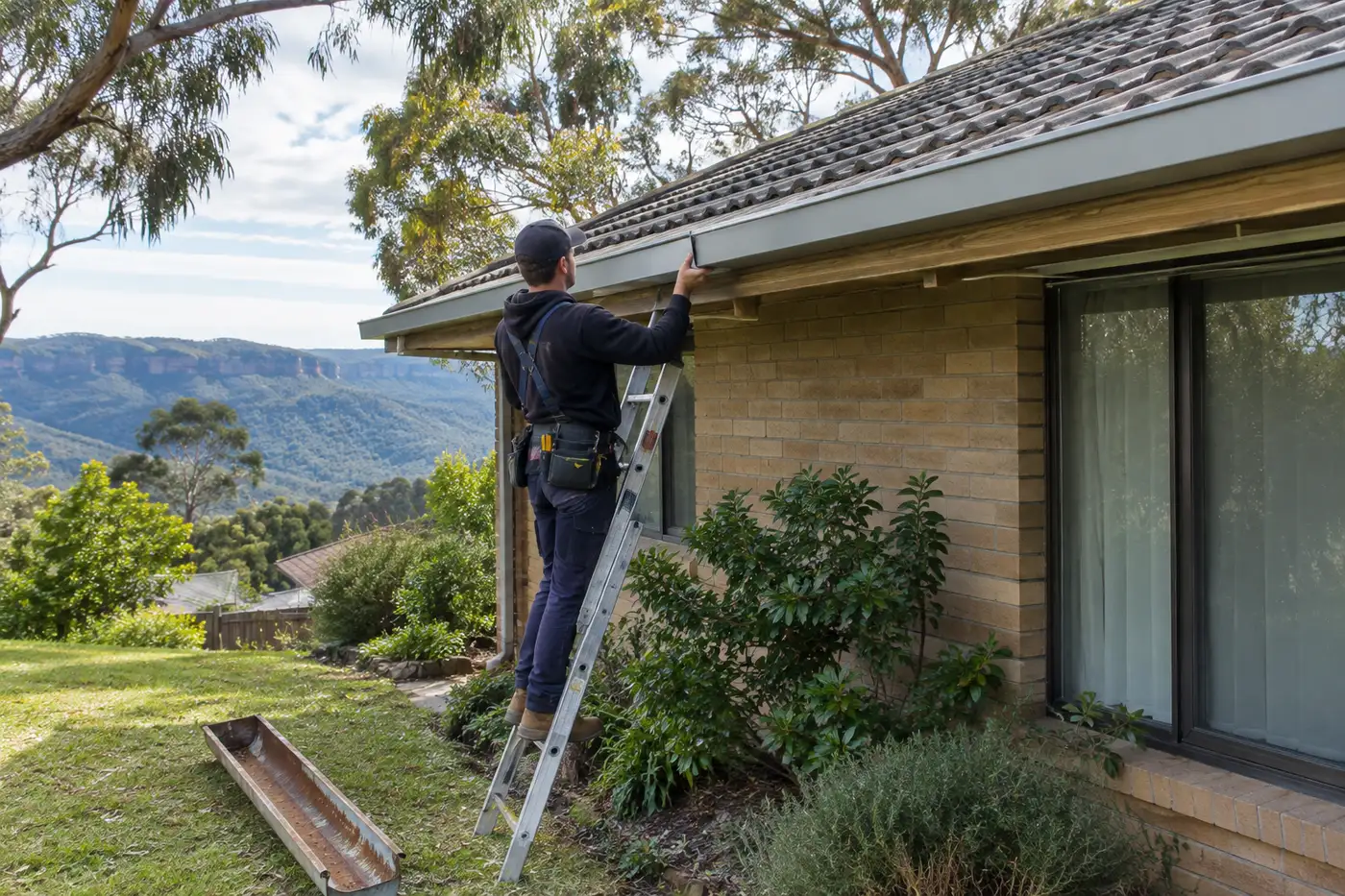
It usually starts with a drip that should not be there. Water spilling over the front of the gutter in a storm, a rust stain creeping down the brickwork, or a gutter that has started to lean away from the house like it has had enough. You go looking for a gutter replacement cost online and find a dozen different answers from a dozen different cities, none of which have seen your house.
We are not going to add another made-up average to the pile. What we can do is explain how a gutter replacement price is actually put together, which parts of the job move the number most, and what to look for when you have two quotes on the kitchen bench that do not match.
Length is the start of the price, not the end of it
Gutters are measured and priced by the lineal metre, so the first thing anyone quoting will do is walk the perimeter and add up every run. A simple rectangular single-storey house has four runs. A house that has been extended, has a carport tacked on, or has a few corners and steps in the roofline can easily have twice as many separate pieces, each with its own ends, corners and joins.
That is why two homes with the same floor area can end up with quite different quotes. Every internal and external corner, every end cap and every join is a spot that has to be cut, fitted and sealed properly. More pieces means more labour, and more places where a careless job will leak.
Downpipes are counted separately. Their cost depends on how many there are, how long each drop is, and whether they connect into an existing stormwater line or need a new outlet position. More on why that last part matters below.
The profile you choose changes the materials and the method
Most homes we work on take one of two gutter shapes. Quad gutter is the familiar D-shaped profile that hangs in front of a timber fascia board on brackets. Fascia gutter is a combined profile where the gutter itself forms the fascia, with no separate timber board behind it. You see it on some brick veneer homes, carports and lean-to additions.
We use Colorbond for both, matched to the roof or trim colour. Swapping like for like is the simplest job. Changing from one profile to another, or going up a size, can involve extra work at the fascia and the roof edge, so it is worth asking about at quote time rather than discovering it on the day.
The fascia is the cost nobody can see from the ground
This is the one that surprises people. When an old gutter has been overflowing or holding water for years, the timber fascia board behind it has often been sitting wet the whole time. From the ground it can look fine. Once the old gutter comes off, the timber can be soft, split or rotted through in sections.
New brackets need solid timber to screw into. If the fascia is rotten, it has to be repaired or replaced before the new gutter goes up, otherwise the new gutter will sag just like the old one. A careful quote will mention this possibility up front and explain how it will be handled if found, rather than leaving it as a surprise variation halfway through the job.
Barge boards (the angled boards along the gable ends of the roof) get checked at the same time, since they often suffer the same way.
Getting water off the roof fast enough matters more up here
A lot of older Blue Mountains homes still have the gutters and downpipes they were built with, and on many mid-century houses those were sized for a smaller roof than the one they now drain. Additions and extensions push more roof area into the same old gutter runs.
Then there is the rain itself. The Bureau of Meteorology station at Katoomba sits at 1,017 metres and records mean annual rainfall around 1,411 mm, and plenty of that arrives in short, heavy bursts. If a gutter overflows in moderate rain even when it is clean, the problem is usually capacity, not condition. Replacing it with the same undersized profile just buys you a shinier version of the same overflow.
The fix might be a larger gutter, an extra downpipe, or moving a downpipe so a long run does not fill from the far end before the water reaches the outlet. Each of those affects the price. Each is also usually cheaper than the water damage an overflowing gutter causes to fascias, eaves and walls over time.
Getting the fall right is part of the same story. New brackets have to be set so the gutter runs downhill to the outlet. Too little fall and water ponds in the gutter, sits there, and starts the rust and rot cycle all over again. It takes a bit longer to set out properly, and it is not the place to save time.
Access on a sloping block is a real line item
Plenty of Mountains homes sit on a slope, so a house that is single-storey at the front can be a long way off the ground at the back. Two-storey gutters, steep blocks and garden beds or tanks hard against the walls all mean more setting up, more safety equipment and more time on ladders or scaffold before any gutter goes up.
That time shows up in the quote. It is not padding. It is the part of the job that keeps the people working on your house safe, and a quote that ignores it is worth asking about.
Full replacement or just one section
Not every gutter problem needs a whole new system, and we would rather tell you that than sell you one. As a rough guide from what we see:
- Leaking joints on gutters that are otherwise straight and sound: reseal the joints
- A gutter sagging away from the fascia: new brackets, or replace that run
- Rust spots or pinholes in one area: replace the affected section, since patches rarely last in this rainfall
- Blocked but sound: a proper clean and flush, not new gutters
- Rust through several runs: full replacement, which works out better value than repeated section repairs and gives one consistent fall the whole way round
If your gutters are blocked more often than they are rusty, the answer may be keeping the leaves out rather than replacing anything. We cover that side in our honest look at whether gutter guard is worth it on a treed Mountains block. Leaf guard can be fitted at the same time as new gutters, and that is usually the tidiest time to do it.
Timing it with other roof work can save a second setup
If your roof itself is due for a restoration or replacement in the next year or two, it is worth thinking about the gutters at the same time. New gutters are a standard part of any full re-roof we do, and doing both together means one setup, one lot of access equipment and gutters sized to suit the new roof. Replacing gutters now and then disturbing them again for a new roof next year is money spent twice.
On the other hand, if the gutters are failing badly and the roof is fine, there is no reason to wait. A gutter that overflows every storm keeps damaging the fascia and the eaves until it is fixed.
How to compare two gutter quotes that do not match
A big gap between quotes is usually a gap in scope, not a gap in honesty. Before you choose on price, check whether each quote covers the same things:
- Removal and disposal of the old gutters and downpipes
- The gutter profile and Colorbond colour, named
- How many downpipes, and where they connect
- What happens if the fascia is rotten once the old gutter is off
- Leaf guard, if you want it, priced as its own line
- A flow test before sign-off
- A written workmanship warranty
If one quote is much cheaper, look for which of those it leaves out. A quote that skips the fascia question or the flow test is not cheaper, it just moves the cost to later.
Our approach on the gutter, downpipe and leaf guard side of the business is a free inspection first, then a fixed written quote that names the profile, colour and full scope before any work starts. Replacement gutters and downpipes are priced on their size, length and profile, so the number reflects your house rather than a national average.
Get a fixed price for your own gutters
The only way to turn all of this into a real figure is to look at the gutters, the fascia behind them and how the water actually leaves your roof. We do that for free and put it in writing. If your gutters are rusting, sagging or spilling over in every downpour, book a gutter inspection and quote or call (02) 4742 0922.