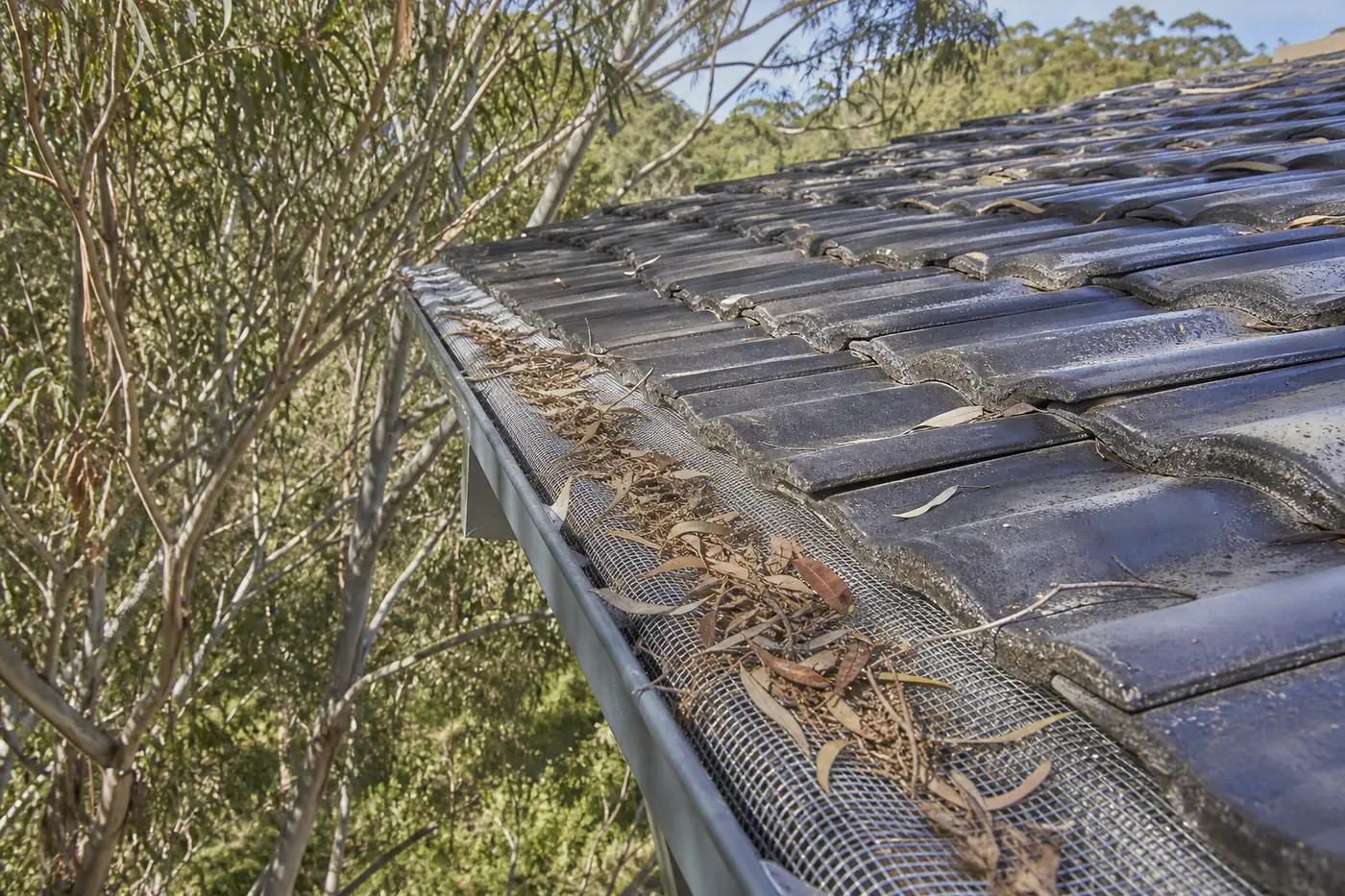
Every autumn we get the same call. The gutters are overflowing again, there is a small forest of gum leaves sitting in them, and the homeowner is standing at the bottom of the ladder wondering whether this is the year they finally do something about it. If you live on a treed block up here, you know the routine. Clean them out, and a few months later they are full again. A gutter guard is what most people are weighing up at that point, and it is one of the most common questions we get asked on a Blue Mountains job.
So here is an honest look at it. Not a sales pitch, and not the version a mesh company gives you. When gutter guard genuinely earns its keep up here, when it does not, what the bushfire side of it really means, and how to think about the cost.
Why your gutters fill up so fast up here
The Mountains are a hard place for gutters. Most blocks have gums, wattles or established garden trees hanging right over the roof, and they drop leaf, bark, twig and seed all year rather than in one tidy autumn dump. Fine gum leaf is the worst of it, because it slips through anything with a coarse gap and packs down into a wet mat in the bottom of the gutter.
Then there is the rain. The upper Mountains gets well over 1,400 millimetres a year around Katoomba, a lot of it in short heavy bursts. When the gutter is already half full of sodden leaf and a downpour arrives, the water has nowhere to go. It backs up, spills over the front, and just as often runs the wrong way, back under the roof edge and into the eaves. On a heavily treed block, blocked gutters are behind a real share of the roof trouble we get called out to.
What a blocked gutter actually costs you
A full gutter is not just untidy. It causes real damage, slowly, and usually somewhere you cannot see. Water that cannot drain sits against the fascia and rots the timber. It overflows back under the tiles and shows up as a stain on the ceiling, which is one of the ways a roof starts leaking in heavy rain even though the tiles themselves are sound. A gutter that stays wet keeps the whole roof edge damp, and a damp shaded roof is exactly where moss and lichen take hold. On a metal roof, standing debris traps moisture against the steel and speeds up rust.
There is a second cost that matters a great deal in this part of the world. A gutter packed with dry leaf and bark is fuel sitting on top of your house. In a bushfire, most homes are lost to ember attack rather than a wall of flame, and embers love landing in a dry gutter. Clearing that fuel out is one of the simplest things you can do for your home, and it is a big part of why people up here look at guttering differently than they would on a bare suburban block.
What gutter guard is, and the part that matters for us
Gutter guard is a cover fitted over the top of the gutter so debris stays out while water still gets in. There are a few types. Cheap plastic clip-in strips are the ones you see at the hardware store, and they tend to warp, sag and let the fine stuff through within a couple of seasons. Foam inserts sit inside the gutter and clog with fine gum leaf fairly quickly. The one worth having on most Mountains homes is a proper aluminium or steel mesh, fixed along the roof and into the gutter so it sheds leaf and keeps the shape.
For a bushfire-prone block the mesh matters even more, because not any mesh will do. To keep embers out, the standard for building in bushfire areas (AS3959) calls for a non-combustible metal mesh with gaps of 2 millimetres or less. Plastic or a coarse mesh does not meet that, and in a real ember shower it can make things worse rather than better. Getting the right material and a clean install is the whole point, which is why leaf guard is part of our gutter and roof drainage work rather than something we treat as an afterthought.
Is it actually worth it?
For a lot of homes up here, yes, and for honest reasons. If you have gums or big trees over the roof, guard cuts how often the gutters clog from several times a year to an occasional check. If you are climbing a ladder to clean two-storey gutters yourself, it takes you off that ladder, and a fall from a roof edge is not a small thing. If your property is in a mapped bushfire area, the right metal mesh removes a genuine ember risk. Those are the cases where it pays for itself, in time, in damage avoided, and in a job you no longer dread.
It is not magic, though, and anyone who tells you it is zero maintenance is overselling. Fine debris, dust and moss can still build up on top of good mesh over time, so it needs an occasional look and a rinse, just far less often. Cheap product badly fitted is worse than no guard at all, because it hides a slowly clogging gutter you have stopped checking. On a block with no overhanging trees, you may honestly not need it. We would rather tell you that than sell you something you will not benefit from.
Should you fit it yourself?
You can buy guard off the shelf, and plenty of people have a go. The trouble is that most of the value is in getting it right. The mesh has to be the correct type and gap for your roof, and for a bushfire rating that is not optional. It needs to sit at the correct fall so water still runs to the downpipes, be fixed so it does not lift in wind, and be dressed properly into the valleys and around the tricky corners where leaf actually collects. Get any of that wrong and you have spent the money and still have a gutter that clogs, plus a mesh that traps water against the roof edge. That is before you get to the fact that fitting it means working along the full edge of the roof, which is where most home ladder falls happen. For a single carport run, fair enough. For the whole house, and especially a two-storey on a slope, it is worth having someone who does it every week.
Check whether your place is bushfire-prone first
One thing worth doing before you decide on mesh type. A large part of the Blue Mountains is mapped as bushfire-prone, but not every block is, and the rating varies street to street. Do not assume, and do not let anyone assume for you. You can check your own address on the NSW Rural Fire Service and Council planning maps, and that tells you whether you need a proper ember-rated mesh or whether you are simply solving a leaf problem. We are happy to talk it through when we look at your roof.
If your gutters fill up faster than you can keep on top of them, or you want the bushfire side of it done properly, that is exactly the kind of job we sort every week across the Mountains, from Glenbrook up to Blackheath. Book a free inspection and quote and we will tell you straight whether guard makes sense for your place, and if it does, get the right leaf guard fitted so you are off the ladder and your roof edge stays clear.