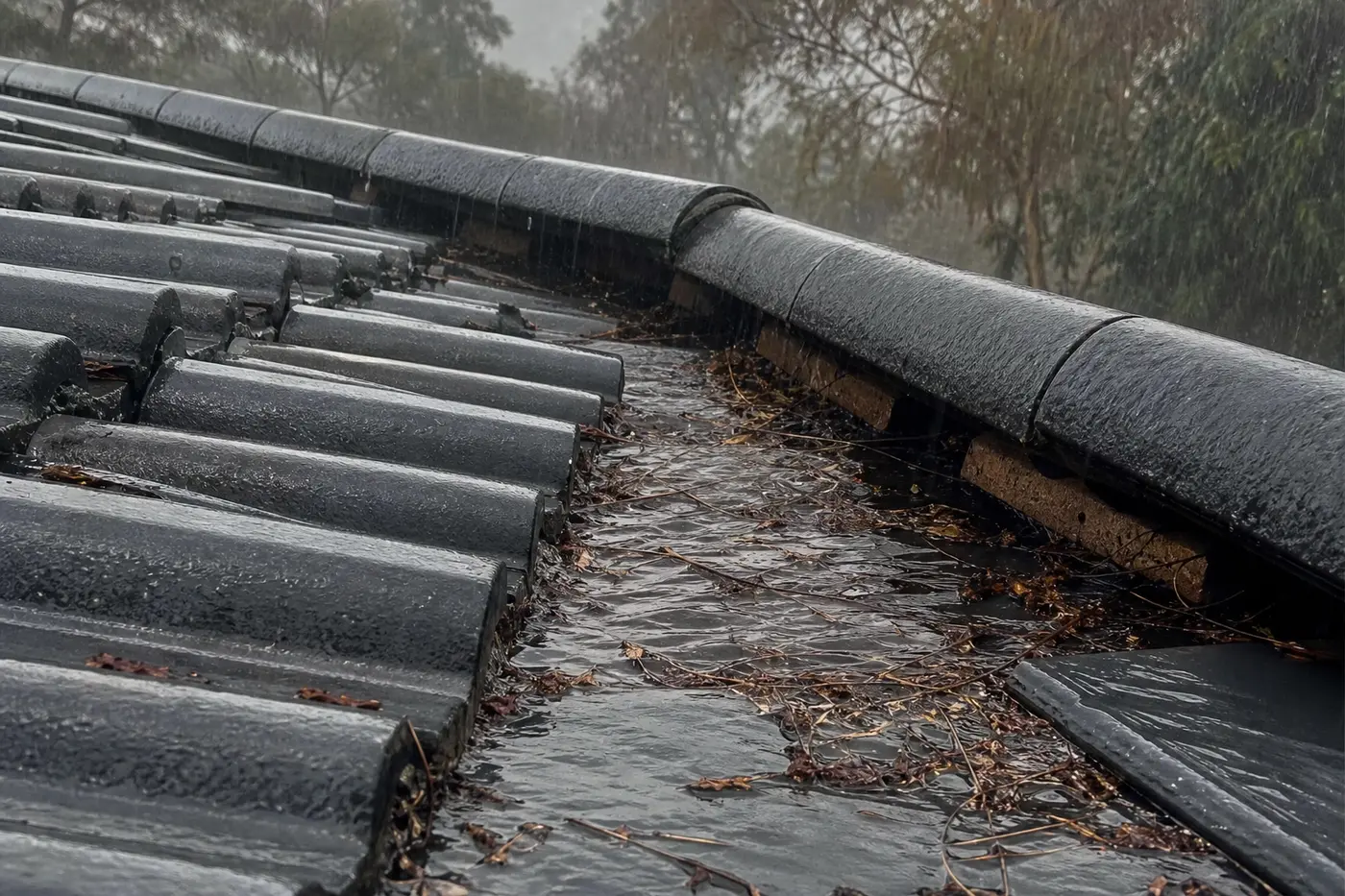
It always seems to happen at the worst possible time. The heaviest downpour of the month rolls through overnight, and by morning there is a brown ring spreading across the bedroom ceiling, or a steady drip landing in a saucepan in the hallway. A roof leaking in heavy rain is one of the most common calls we get up here, and it tends to arrive in a cluster, the morning after a proper Mountains storm has been through.
The frustrating part, and the part that catches people out, is that the roof was fine last week. It coped with the light stuff all autumn. Then one big night of rain and suddenly the ceiling is wet. Here is why that happens, where the water is usually getting in, and what to do about it before the damage spreads.
Why the roof holds up until the rain gets serious
A roof does not have to be watertight to survive gentle rain. Tiles overlap, water runs down the surface, and gravity does most of the work. Light rain drains off before it can find a weak point. Heavy rain is a different animal. The sheer volume overwhelms gutters and valleys, so water backs up and sits where it should be running away. Wind drives the rain sideways and even upward, pushing it back under the overlaps between tiles and behind flashings that a vertical drizzle would never reach.
Up here that matters more than most places. The upper Mountains cops well over 1,400 millimetres of rain a year around Katoomba, a lot of it in short, hard bursts, and a southerly can throw it at the roof from an angle all night. A small fault that stays dry in ordinary weather becomes an open door the moment the rain turns heavy and the wind gets behind it.
Where the water is actually getting in
Most leaks we chase come down to a handful of usual suspects. On the tile roofs that make up most of the housing here, the common ones are:
- Cracked mortar along the ridge caps, so water runs straight into the roof below the capping.
- Valleys that are rusted through or packed with gum leaves, so the water dams up and spills sideways under the tiles.
- Flashing that has lifted or perished around a chimney, a skylight or where the roof meets a wall.
- Cracked, slipped or porous tiles, often ones that looked fine from the ground.
- Gutters so full of leaf litter that they overflow back into the eaves.
Metal and Colorbond roofs leak for their own reasons: rusted-out sheeting, failed sealant around screws and fasteners, and the same flashing and valley trouble as tile. On the heavily treed blocks that are normal up here, blocked valleys and gutters are behind a surprising share of the leaks we see. Leaf litter holds water against the roof and stops it draining, and heavy rain is when that finally bites.
The stain on the ceiling is rarely under the hole
This is the bit that surprises people most. Water almost never drops straight down from where it entered. It gets in at a cracked ridge or a lifted flashing, runs along the sarking, the battens or a rafter, sometimes several metres, then finds a low point and drips. So the wet patch on your ceiling can be a long way from the actual fault. Poking around directly above the stain, or dabbing sealant on the nearest visible crack, usually treats the wrong spot and the leak comes straight back with the next storm.
That is why finding the real source is a job worth doing properly rather than guessing at. We work back from where the water shows up inside, follow the path it took, and test until we can prove where it started. If you want the detail on how that is done, our page on pinpointing and fixing a roof leak walks through it. Getting the source right the first time is the whole game, because a repair aimed at the wrong place is just money down the drain.
What to do the moment you spot it
You do not need to fix the roof yourself, and you should not be climbing onto a wet one in a storm. But there are a few sensible things that limit the damage while you wait for someone to get there. Move furniture, rugs and anything electronic out from under the drip, and put down a bucket or a bin with an old towel in the bottom to kill the noise. If part of the ceiling is sagging and bulging with trapped water, it is safer to pierce it with a screwdriver over a bucket and let it drain than to let the whole sheet come down at once. Keep well clear of any light fitting or power point near the water, and if it is close to wiring, switch that circuit off at the board.
Then get your phone out and photograph everything, the ceiling, the walls, any ruined belongings, before you clean up. Those photos matter later if you end up making a claim. A cluster of towels and buckets is not a fix, but it buys you time and keeps a nuisance from turning into a ruined ceiling.
Storm damage, wear and tear, and your insurance
One of the first questions people ask is whether their home insurance will cover it. The honest answer is that it depends on why the roof leaked. Sudden, identifiable storm damage, a tile smashed by a falling branch, a section of roof lifted in high wind, is often covered. A leak that comes down to age, rust or years of blocked gutters and neglected maintenance usually is not, because insurers treat that as wear and tear you were meant to keep on top of. Every policy is different, so read yours or call your insurer before you assume either way. This is where those early photos earn their keep, and it is one more reason not to sit on a leak, because a delay that lets the damage grow can count against a claim.
Getting it fixed so it stays fixed
Once the source is confirmed, the repair itself is usually straightforward: re-bed and repoint the ridge caps, replace a rusted valley, renew the flashing, swap out the cracked tiles, clear and reset the drainage. Cracked ridge mortar is such a common culprit that we have written a separate piece on the signs your ridge capping is due for repointing, which is worth a read if that turns out to be your problem. Where a leak is really a symptom of a roof that is worn out across the board, a patch is a false economy, and that is a conversation we would rather have honestly and up front. Our repairs carry a 2-year workmanship warranty, conditions apply.
If your roof is leaking every time the weather turns, do not wait for the next downpour to make it worse. We give free, no-obligation inspections and quotes right across the Mountains, from Glenbrook up to Blackheath, and we will find the actual source rather than guess at it. Book a roof leak inspection and we will tell you straight what is going on up there and what it takes to put it right.