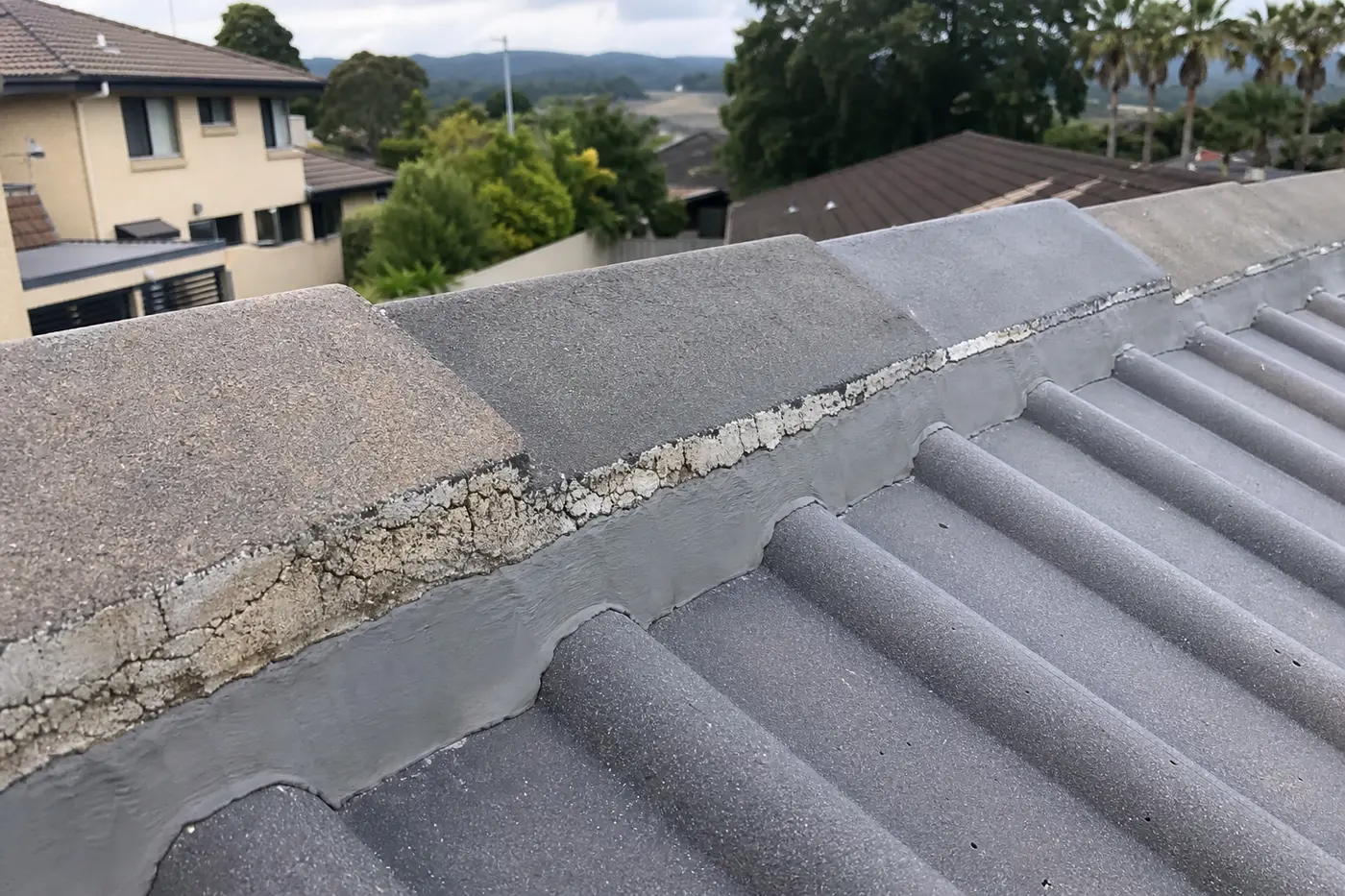
The first sign is usually a bit of grey grit in the gutter, or a small pile of sandy crumbs on the path after a windy night. Most people never look up at the ridges of their own roof, so the line of mortar that runs along the top and down the hips does its job quietly for years and then starts letting go without much of an announcement. By the time a cap slips or a leak shows on a bedroom ceiling, the roof has needed repointing for a while.
Roof repointing is one of those jobs we get asked about a lot up here, and it is worth understanding before you spend anything, because the word gets used loosely. So here is what it actually means, why Blue Mountains roofs tend to need it sooner, and how to tell when yours is due.
The mortar along your ridges holds the roof's edges down
Look up at any tiled roof and you will see the capping tiles that run along the very top (the ridge) and down the sloping corners (the hips). Those caps cover the gap where two runs of tiles meet, and they are held in place by mortar. That mortar line is the weak point of an otherwise tough roof. Water, wind and time all work on it, and once it goes the caps are loose and the gaps underneath are open to the weather.
Bedding and pointing are two different things
This trips a lot of people up, so it is worth a minute. The bedding is the bed of sand-and-cement mortar that the ridge cap actually sits on. The pointing is the flexible compound applied over the top of that bedding, sealing the join between the cap and the tiles. Bedding is the structural part. Pointing is the weatherproof skin.
Repointing means removing the old, cracked surface layer and running a new flexible compound over the bedding. Re-bedding is the bigger job: lifting the caps off, raking out the failed mortar bed underneath, and setting them again on fresh mortar before pointing over the top. A roof with sound bedding might only need repointing. A roof where the caps have gone hollow and rocky usually needs re-bedding as well. A proper look is the only way to know which, and a good roofer will tell you plainly.
Why our roofs lose their pointing sooner
Older roofs around the Mountains were pointed with a rigid sand-and-cement mix. That mix is brittle. A roof expands under the afternoon sun and contracts again overnight, and up here the swing is real, so the rigid mortar develops hairline cracks. Then the weather gets into them.
The upper Mountains sees well over 1,400 millimetres of rain a year around Katoomba, plus fog that keeps everything damp long after the rain has stopped, and hard frosts through winter. Water sits in those hairline cracks, and when it freezes it expands and opens them wider. That freeze and thaw cycle, season after season, is hard on old cement pointing. Add the moss and leaf litter a shaded, treed block collects and the mortar stays wet and breaks down faster still. It is the same damp that feeds moss on the tiles, so the two problems often turn up together.
Flexible pointing, which is what we use now, is made to move with the roof instead of cracking. That is the single biggest reason a modern repoint outlasts the old cement work.
The signs your ridge capping is due
You can spot most of these from the ground with a decent look, and binoculars beat climbing a ladder. Here is what we look for:
- Hairline cracks or missing chunks in the mortar line along the ridges and hips.
- Sandy, gritty debris in the gutters or on the ground below the eaves.
- A ridge cap that sits slightly crooked, or shifts when the wind is up.
- Moss or weeds growing straight out of the mortar joint.
- A damp patch or stain on a ceiling directly below a ridge or hip line.
One or two hairline cracks on an otherwise tidy roof is a watch-and-wait. Several loose caps, crumbling mortar and a stain on the ceiling means water is already getting in, and that is worth acting on before the next big southerly.
Repoint, re-bed, or is the whole roof past it?
Repointing is a maintenance job, not a rescue. If the tiles themselves are sound and only the ridge mortar has failed, repointing (with re-bedding where the caps need it) adds years to the roof for a fraction of the cost of anything bigger. It is also a standard part of a full restoration, so if you are already having the roof cleaned and coated, the pointing gets rolled into that work. If you want to see where it sits in the bigger picture, we have set out what a full roof restoration costs separately.
Sometimes, though, the pointing is just the symptom. If the tiles are cracked and porous across the whole roof, or a terracotta roof on an older Federation home has simply reached the end of its run, fresh mortar on the ridges will not save it. That is the point to weigh up a restoration against a full re-roof before spending anything on the caps alone.
Why this is not a ladder-and-a-bag-of-mortar job
People do ask whether they can repoint the ridges themselves, and I understand the thinking, because it looks like buttering a line of mortar along the top of the roof. In practice it rarely goes well. Getting onto a pitched roof safely is the first problem, and Blue Mountains roofs are often steep, high off a sloping block, and slippery with moss or frost for half the year. The second problem is that smearing new mortar over old, failed pointing without dealing with the bedding underneath just hides the trouble for a season, then the caps move again. Doing it properly means clearing the old material back, checking the bed the caps sit on, and laying flexible pointing at the right consistency so it cures without cracking.
This is the everyday work of our ridge capping, re-bedding and repointing service, and it is one of the more straightforward ways to protect a roof when it is caught in time. Our workmanship is backed for seven years as part of a full restoration and two years on repairs, conditions apply.
Get the ridges checked before the leak
If you have noticed grit in the gutters or a cap that looks a bit off, it is worth a proper look now rather than after it has stained a ceiling. We will get up on the roof, tell you honestly whether it is a repoint, a re-bed or something bigger, and give you a free quote either way. Book a roof inspection and we will take a look at your ridge lines.