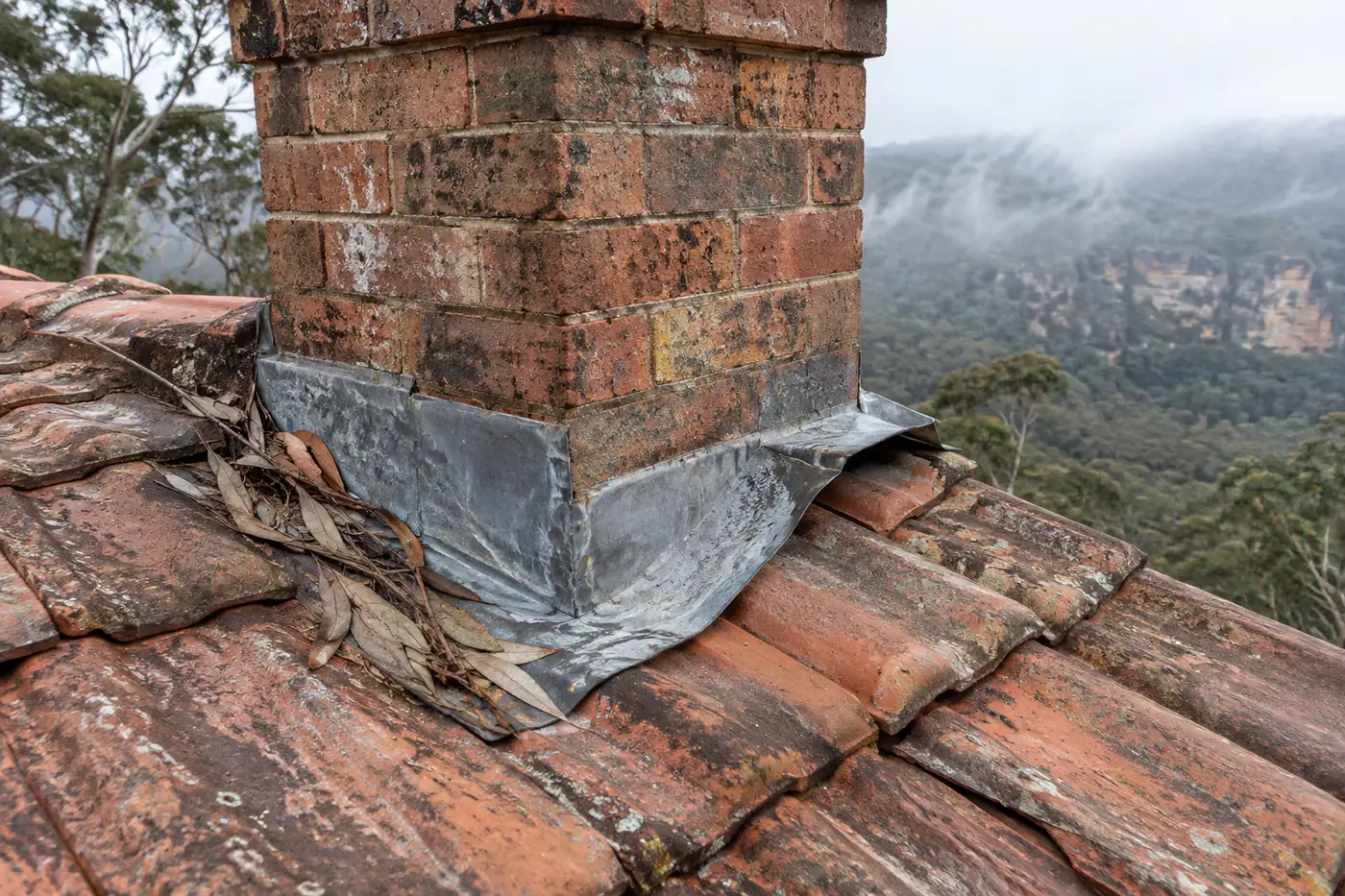
The call usually goes something like this. A damp patch has appeared on the ceiling beside the chimney breast, or a brown streak is creeping down the wall under a skylight. It only shows up after a southerly has thrown rain at the house all night. From the backyard the tiles look perfectly fine, and the gutters were cleaned in autumn. So where is the water coming from?
Very often the answer is the flashing. Flashings around chimneys, skylights, parapet walls and dormer windows are a common entry point for leaks on Blue Mountains roofs, and roof flashing repair is a job we quote on regularly from Glenbrook to Blackheath. Here is what flashing actually does, why it gives out, how to spot the warning signs from the ground, and what a repair that lasts should involve.
Flashing seals the joins that tiles and sheets can't
Tiles and metal sheets are good at shedding water across the open slope of a roof. The trouble starts wherever the roof meets something else: a chimney, a wall, a skylight, a vent pipe, or the point where an extension joins the original house. Each of those is a join, and a join is a gap.
Flashing is the strip of material that covers that gap and turns the water back onto the roof. On a typical older chimney there are several pieces working together. An apron sits across the downhill face. Soakers or step flashings are tucked under the tiles up each side. A counter flashing is set into the brickwork above and laps down over the top of the rest, so water running down the chimney can't get behind them. Pipes and vents have their own collars or boots.
The material varies with the age of the house. We see lead, aluminium and zincalume flashings across the Mountains, and on some older tile roofs there is no metal at all, just a fillet of mortar where the tiles meet the wall. That last one is the most likely to crack.
Why flashings up here give out
Flashing lives a hard life. It sits in full sun, it expands in summer heat and shrinks on frosty nights, and it is fixed to two things (the roof and the chimney or wall) that move at different rates. Over years that movement fatigues the metal, pulls fixings loose and cracks the mortar holding the counter flashing into its groove in the brick.
The weather makes it worse. The Bureau of Meteorology's Katoomba station records mean annual rainfall of around 1,411 mm, and a lot of that arrives sideways on the wind. A flashing with a small lift at one corner will stay dry in drizzle for years and then let water straight in during one hard night.
Trees play a part too. The uphill side of a chimney is a natural dam, and on the leafy blocks so common up here it fills with gum leaves and bark. Wet debris holds water against the flashing long after the rain stops, which speeds up corrosion and can push water over the top edge.
Then there is age. Heritage homes in the Mountains' conservation areas often still have original flashings that are 50 to 80 years old. Lead flashings from the mid 20th century can still be serviceable if they are undamaged, but the ones around chimneys and parapet walls have usually been disturbed over the decades by aerial installers, chimney work or previous repairs.
The warning signs, and where to look for them
Please don't climb up to check. Wet tiles are a slip hazard, and old flashing has sharp edges. Most of what you need to see is visible from the ground, ideally with a pair of binoculars, or from inside the house.
- A stain on the ceiling or wall near a chimney breast, skylight, or the line where an extension meets the house
- A leak that appears in wind-driven rain but not in steady, still rain
- Flashing edges that are lifted, creased or standing proud of the tiles
- A counter flashing pulled out of its groove in the brickwork
- Cracked or missing mortar where tiles meet a wall
- Rust streaks running down the roof below a flashing
- Thick beads or blobs of silicone, which tell you someone has already tried a quick fix
If you can safely look into the roof space with a torch, dark water marks on the timbers around the chimney are another giveaway. One caution: water travels along battens and rafters before it drips, so the stain on your ceiling may be a metre or more from where it got in. That is why we always diagnose from the roof, and why tracing a leak back to its real entry point comes before any repair.
A tube of silicone is a patch, not a repair
This is a fix we find ourselves undoing all the time. Silicone or roof sealant smeared along a gap looks tidy for a season. Then sun and movement break the bond, and the bead lifts at one end. Worse, it can trap water behind it, so the flashing rusts from the back while looking sealed from the front.
A proper repair depends on what has actually failed, and it is one of these, roughly from smallest to largest:
If the flashing itself is sound but has lifted, it can often be dressed back down and refixed. If the counter flashing has pulled out of the brickwork, the groove is cleaned out and the flashing reset and repointed. If a section is perished, rusted or torn, that section is replaced. And if a chimney's whole set of flashings has had it, we replace the apron, soakers and counter flashing together, because fixing one piece and leaving the others usually just moves the leak.
Material choice matters on metal roofs. Water running off lead onto zincalume or Colorbond sheeting can corrode the sheet, so when we replace flashing on a metal roof we use a compatible material rather than whatever was there before. You can read more about our flashing and general roof repair work, including what each repair covers.
If your home is in a heritage conservation area, check with Blue Mountains City Council before visible roof materials are changed. Heritage status is property specific, so it is worth confirming against Council mapping rather than assuming either way.
Flashing problems rarely travel alone
When a flashing has failed through age, the parts of the roof around it are usually the same age. On tile roofs we often find the nearby valley is rusting or packed with leaves, or the ridge mortar is cracking along the same stretch. On metal roofs, the fixings and lap joints near the flashing are often starting to rust as well. If your leak only shows up in a downpour, our guide to the other places water gets in during heavy rain covers those usual suspects.
That is not a reason to do everything at once. It is a reason to have the whole area looked at while someone is up there, so you can decide what is urgent and what can wait.
What to expect when you call us
We start with a free inspection on the roof, not from the driveway, and photograph what we find. You get a fixed written quote with the urgent items separated from the ones that can reasonably wait. If water is actively coming in, we can weatherproof the area so it stops getting worse while the full repair is scheduled. Once the work is done we re-check the entry point before we leave, and you receive photos of the finished job with a 2-year workmanship warranty on repairs (conditions apply). If the flashing work is part of a full restoration or re-roof, the workmanship warranty is 7 years.
If you have a damp patch by the chimney, a skylight that weeps in a storm, or a flashing you can see lifting from the yard, have it looked at before the next big front comes through. Book an inspection through our Blue Mountains roof repairs page or call (02) 4742 0922 for a fixed quote.