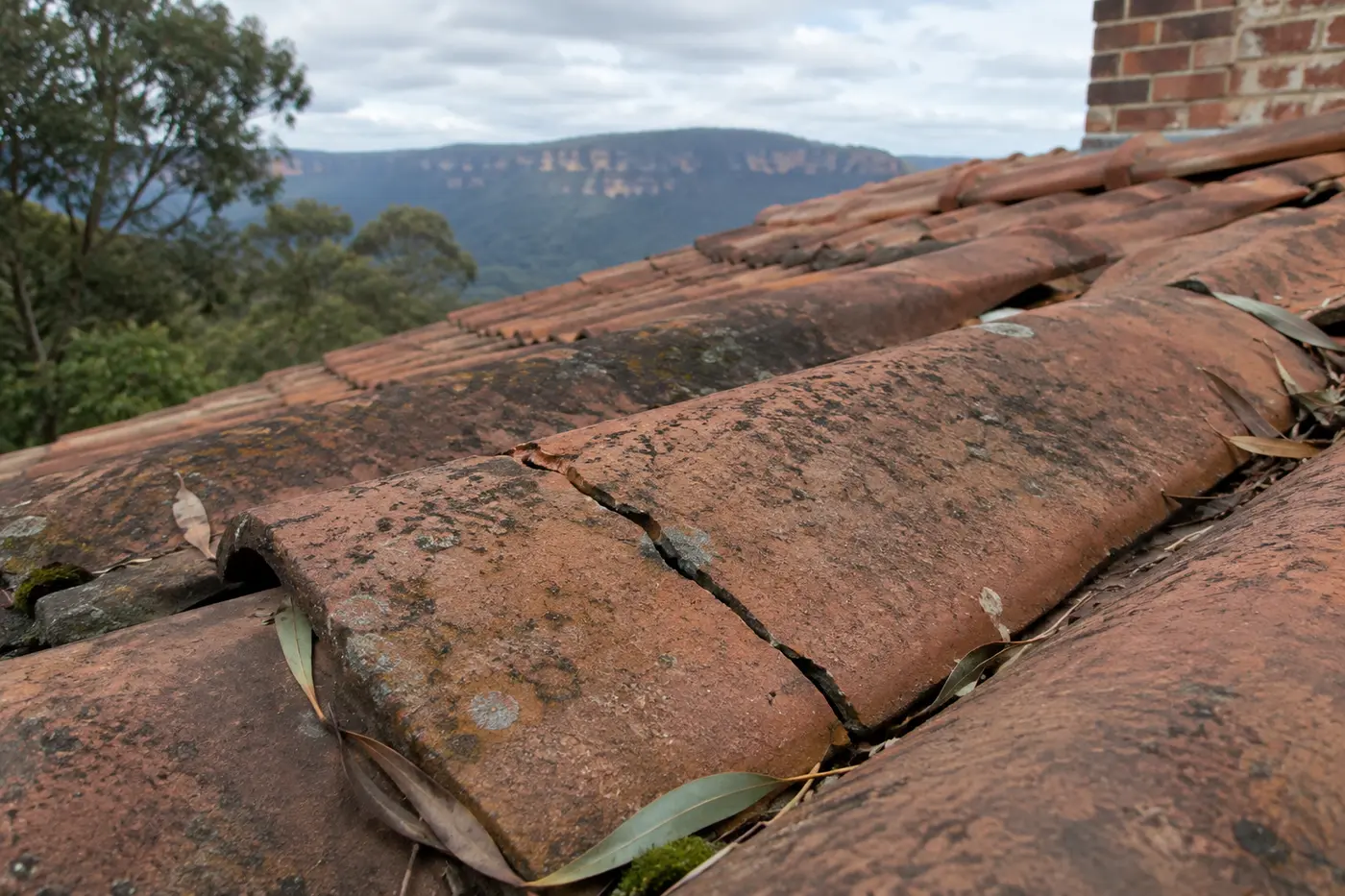
Maybe you noticed it from the back deck. One tile with a dark line running across it, or a corner that has dropped away. Maybe the solar installers were up there last month, or a big branch came down in the last storm. Or a piece of orange clay turned up in the gutter and you have no idea where it came from.
Cracked roof tiles are one of the most common things we get called out for across the Mountains. Most of the time they are a small, straightforward repair. Left alone, though, they turn into a leak, and a leak turns into wet timber, stained ceilings and a much bigger bill. Here is what causes them, how to spot them without climbing up, and what a proper fix looks like.
A cracked tile may not be leaking yet, but it will
A tiled roof works by overlap. Each tile sits over the one below and beside it, so rain runs across the surface and down into the gutter. The tiles themselves are the waterproof layer. A crack breaks that layer.
In light rain, water often runs straight past a fine crack and nothing happens inside. That is why so many people see a cracked tile, check the ceiling, find nothing and forget about it. Then a heavy storm arrives with wind behind it, water is driven sideways into the crack, and it drips through.
Where it goes next depends on what is under your tiles. Some roofs have sarking, a reflective membrane laid under the battens that catches stray water and carries it to the gutter. Plenty of older homes were built without it. On those roofs, water coming through a cracked tile lands on the battens, the insulation or the back of the ceiling, with nothing in between.
Feet, branches and weather crack most tiles
When we trace a cracked tile back to its cause, it is usually one of a handful of things.
People walking on the roof. This is the big one. Tiles are strong where they are supported and weak where they are not, and a boot in the wrong spot snaps them. Aerial installers, solar crews, someone clearing the gutters: we see the trail they leave all the time. Old terracotta is especially brittle, and it often cracks underfoot without a sound.
Falling branches. Mature eucalypts are part of living up here, and so are the limbs they drop in wind. Even a modest branch falling from height can crack several tiles at once.
Hail. A hard hailstorm can crack tiles across a whole slope, and the damage is not always obvious from the ground straight away.
Cold and wet. The Bureau of Meteorology's Katoomba station sits at 1,017 m and records mean annual rainfall around 1,411 mm. On older terracotta that has gone porous, water soaks into the tile, freezes on a cold night and slowly breaks the surface apart. This is more of an upper Mountains problem than one for Glenbrook or Blaxland.
Movement plays a part too. Cut tiles along valleys and hips, and tiles that were never fixed down properly, can shift and crack over the years.
Most cracks can be spotted from the ground
Please don't climb up to check. A tiled roof is slippery and easy to fall from, and as above, walking on it is how most tiles get broken in the first place. You can learn a lot from the yard with a pair of binoculars, or from an upstairs window.
Look for straight dark lines across a tile, corners or edges missing, and tiles that sit higher or lower than their neighbours. Check the gutters for chips and fragments. After a storm, pay attention to the part of the roof under any overhanging tree.
Inside, a brown ring on the ceiling is the obvious sign, but it is not the earliest one. If you can get into the roof space safely with a torch, look for pinpricks of daylight, damp or darkened timber, and wet patches on the insulation. Water runs along battens before it drips, so a ceiling stain can be some distance from the tile that caused it.
Sealing a crack buys time, replacing the tile fixes it
There are sealants and patching products sold for cracked tiles, and plenty of videos showing them in use. A patch has its place: if water is coming in right now and a proper repair is a few days away, sealing the crack can stop the damage spreading. It is a stopgap, though. Sealant ages faster than the tile, and a crack that has opened once usually keeps opening.
The lasting fix is to take the cracked tile out and fit a sound one in its place. On paper that sounds simple. In practice it means lifting the surrounding tiles without cracking those as well, checking the battens and anything else underneath for water damage, and making sure the new tile sits and locks in exactly as the old one did. On a steep or two-storey roof, getting up there safely is a job in itself.
This is everyday work for us. Our tile and metal roof repairs cover cracked, broken and slipped tiles, and while we are up there we look at what caused the damage, so it doesn't simply happen again next season.
Finding a matching tile is the part people don't expect
A replacement has to be the same profile, or it won't interlock and seal with the tiles around it. Standard concrete profiles are usually easy to source. Older terracotta can be harder, and some heritage profiles are no longer made, which can mean tracking down salvaged tiles. If you are not sure which type you have, our guide to telling terracotta and concrete tiles apart covers the checks you can do from the ground.
Colour is a separate question from fit. A brand new tile can stand out against a roof that has weathered for decades. Some owners are happy with that. Others prefer to move a few original tiles from a less visible slope to the front and put the new ones out of sight.
One cracked tile is a repair, cracks everywhere is a different conversation
A few cracked tiles on an otherwise sound roof is a quick job, and repairing them is the right call. It changes when the cracking is spread across the roof, the tiles have gone porous, the ridge mortar is crumbling and you have already paid for a couple of patch jobs. At that point you are fixing symptoms on a roof that is wearing out as a whole.
That is when a restoration starts to make more sense than another round of repairs, and we will tell you plainly which situation you are in. If you want a feel for how a repair price is put together before anyone climbs up, our breakdown of what drives the cost of a roof repair explains the broad sizes of job and what pushes each one up or down.
If it is already leaking, do these things first
Put a bucket under the drip and move anything valuable out of the way. If the ceiling is sagging or bulging with water, keep people out of that room and switch off any light fitting in that part of the ceiling. Take photos of the ceiling and, from the ground, of the roof. Then call a roofer. Nobody should go up on a wet tile roof, and that includes us until it is safe.
If you have spotted cracked tiles, or you suspect them after a storm or after trades have been on the roof, book a free inspection through our roof repair service. We'll find every damaged tile, check what is underneath, and give you a fixed written quote. Repairs carry our 2-year workmanship warranty, conditions apply.