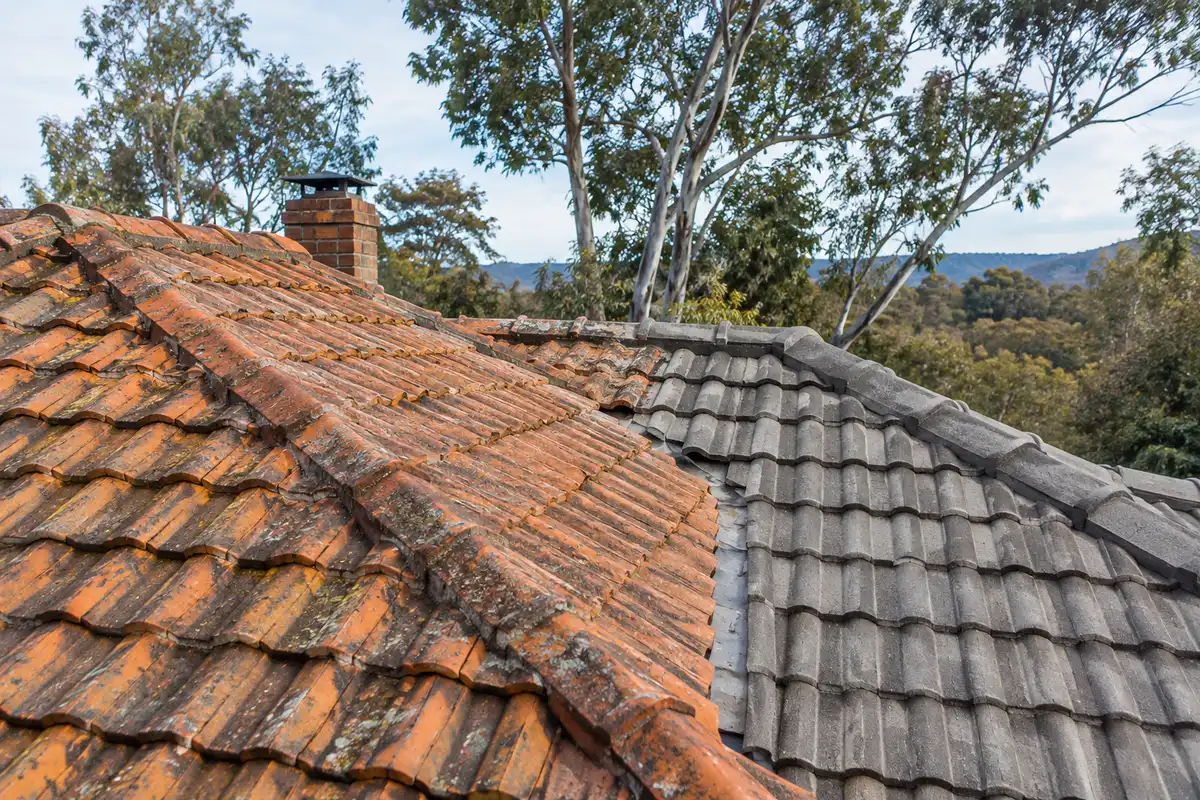
Here is a situation we hear about more than you would expect. Two roofers look at the same roof a few weeks apart. One says it needs a clean and a fresh coat. The other says it should never be painted at all. They cannot both be right, and usually the whole disagreement comes down to one question: are the tiles terracotta or concrete? Answer that, and most roofing advice starts to make sense.
That is why terracotta vs concrete roof tiles matters even if you are not building a new house. The type of tile on your roof decides how it ages, what maintenance it needs, what a repair involves and roughly what you will spend over the years. From the street, at a distance, the two can look almost the same.
Two tiles, made in completely different ways
Terracotta is clay that has been shaped and fired in a kiln, the same basic idea as a flowerpot or a clay brick. The colour goes right through the tile. Some terracotta is left with a plain, slightly rough sand finish. Some is glazed, which gives it a smooth, glassy surface that shines a little in the sun.
Concrete tiles are sand and cement moulded into shape and left to cure. They are not fired. The colour mostly sits on the surface, as a coloured coating applied at the factory, while the body of the tile underneath is grey.
That one difference, where the colour lives, explains most of what follows.
How to tell which tiles are on your roof
You do not need to climb up to find out, and please do not, because tile roofs are easy to crack and easier to fall off. A few checks from the ground or a window usually settle it.
- Look at a broken or chipped edge. A spare tile in the garage or a chip near the gutter tells the story. Terracotta is the same orange or red colour all the way through. Concrete shows grey inside a coloured skin.
- Check the shine. A glossy surface almost always means glazed terracotta. Concrete tiles have a flat, slightly gritty look.
- Look at the thickness. Concrete tiles tend to be chunkier with softer, rounded edges. Terracotta profiles are usually thinner with crisper edges.
- Think about the age of the house. It is only a clue, not proof, but it helps.
On that last point, the Mountains has a fairly clear pattern. The Edwardian and Inter-War homes of Katoomba, Leura and Wentworth Falls often still carry terracotta, some of it original sand finish and some glazed tiles fitted in later decades. Down around Springwood, Blaxland and Glenbrook, most of the post-war suburban roofs we look at are concrete, laid from the 1960s through to the 1990s. The mid-Mountains towns are a genuine mix. And plenty of homes have both, with a terracotta main roof and a concrete extension added later.
Concrete tiles depend on their coating
Concrete is the cheaper tile to supply, which is a big part of why it covered so much of the post-war building boom. It is also a forgiving tile to work on. It copes better with being walked on than old terracotta does, and replacement tiles in standard profiles are easy to get.
The catch is that factory colour coat. Over the years it fades and turns chalky, and once it wears through, the bare concrete underneath starts to soak up water. A roof that holds water holds moss and lichen too. Most of the faded, blotchy concrete roofs we see around the lower Mountains are not failing tiles. They are tiles that have lost their protective skin.
The good news is that this is very fixable. A worn concrete roof can be cleaned, repaired, primed and given a new protective coat, which is exactly what a restoration is.
Terracotta keeps its colour but does not like feet
Because the colour is fired right through, terracotta does not fade the way concrete does. A terracotta roof can look much the same after decades as it did when it went on. That is a large part of its appeal, and on a period home it is often a large part of the character too.
The weakness is that fired clay is hard but brittle. Old terracotta cracks under a careless boot, which is why so much damage on these roofs is caused by people walking on them: aerial installers, solar crews, even well-meaning owners clearing a gutter. We walk these roofs very carefully and step only where the tile is supported.
Aged sand-finish terracotta also becomes more porous as its surface weathers. Glazed tiles are a different story again. The glaze stops a coating from sticking, so glazed terracotta should not be painted at all. This is exactly where those two opposite quotes come from. Paint a glazed roof and you have paid for a coat that will peel.
What the Mountains weather does to each tile
Up here the weather does most of the damage, and it treats the two tiles differently. The Bureau's Katoomba station sits at 1,017 m and records around 1,411 mm of rain a year. Add fog, long damp spells and frost in the upper Mountains, and any tile that holds water has a hard time.
On concrete, the damp mostly shows up as moss, lichen and a tired, stained surface once the coating has gone. On porous old terracotta, water that soaks into the tile can freeze on a cold night and slowly break the surface away, and the damp also speeds up the decay of the mortar bedding under the ridges. On both, the ridge mortar takes a beating from repeated freezing and thawing, which is why rebedding and repointing comes up so often on roofs of either type.
The lower Mountains is warmer and drier than Katoomba, so frost is less of a factor down there. Tree debris in valleys and gutters is a problem everywhere, though.
Replacing broken tiles is easier with concrete
This one surprises people. Swapping out a few cracked tiles is usually straightforward on a concrete roof, because standard profiles are widely available and a close match is easy to find.
Terracotta can be harder. Older and heritage profiles are not always still made, and finding matching tiles can mean going to specialist or salvage suppliers. On a heritage property in a conservation area, the better option is often careful repair of the original tiles rather than replacing them, and any change to the visible look of the roof should be checked with Blue Mountains City Council first. Heritage status depends on the property, not the street, so check Council mapping for your address rather than going by what the neighbours were told.
We do both kinds of repair, from single cracked tiles through to full relays, as part of our concrete and terracotta tile work across the Mountains.
Choosing between them for a new roof
If you are re-roofing or building and you have settled on tile, the choice usually comes down to three things.
Budget. Concrete is generally the cheaper tile to supply, and terracotta is usually the dearest. Labour is a big part of any roof, so get a written quote for your roof rather than going by the price of the tiles alone.
Upkeep. Concrete will need recoating at some point in its life. Terracotta's colour lasts, but the roof still needs its ridges, valleys and flashings looked after. Neither is maintenance free, and for rough lifespans of each, see how long tile roofs last in the Mountains.
The house itself. Terracotta suits Federation and Inter-War homes and is often expected in heritage areas. Concrete sits naturally on post-war and later homes. If your roof is in a conservation area, Council may have a view on which you can use.
If you are weighing up tile against metal as well, that is a separate decision, with weight and noise in the mix. Our Colorbond vs tile comparison covers that side.
Not sure what is on your roof?
If you cannot tell which tiles you have, or you have had two roofers tell you opposite things, the answer is a proper look from someone who works on both types. We will tell you what your tiles are, what condition they are in and whether they need a coat, a repair or simply leaving alone. Call us on (02) 4742 0922 or book a tile roof inspection anywhere from Glenbrook to Blackheath.