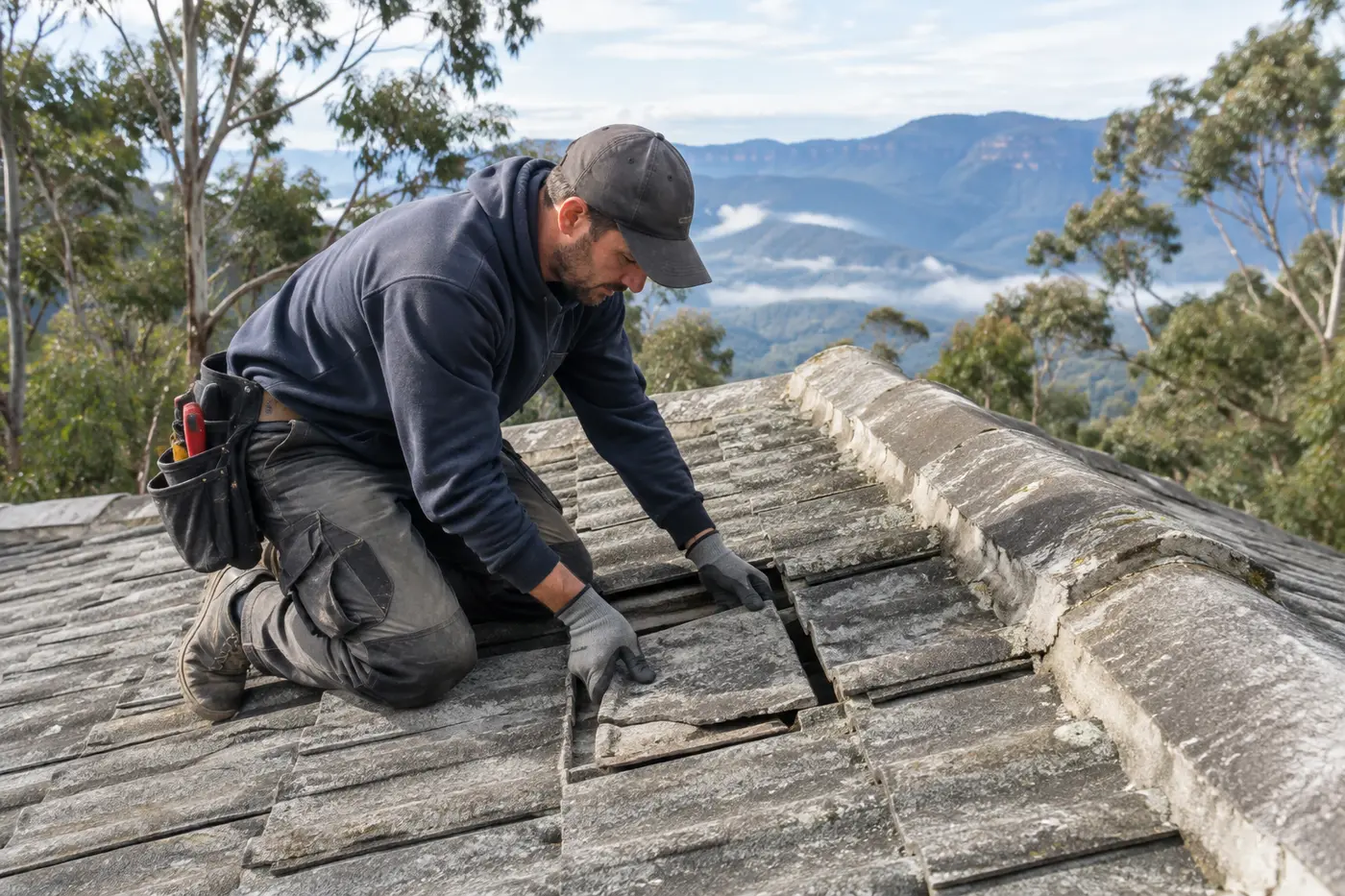
There is a brown ring on the hallway ceiling, or a ridge cap you swear has moved since last winter. You ring a couple of roofers and ask the obvious thing: roughly what will this cost? And you get a careful non-answer. It is frustrating. It is also, usually, the honest reply, because roof repair cost depends almost entirely on what is wrong, and nobody knows that until someone has been up there.
So this guide does not pretend to give you a price list. What it does is explain how a repair price gets built, what makes one job a quick fix and another a full day, and how to tell whether the quote in front of you is fair.
The symptom tells you very little about the bill
A water stain is a symptom. The fault behind it could be one cracked tile, a run of ridge mortar that has let go, a rusted valley or a flashing pulling away from the chimney. Those are very different jobs. One is a short visit. Another means pulling up and relaying a whole section of roof.
Water also travels. It runs along battens and sarking before it drips onto the ceiling, so the stain is often nowhere near the hole. We explain how that happens in our guide to why a roof leaks when the rain gets heavy. For pricing, the point is simple: two leaks that look identical from inside can have completely different repair bills.
That is why we inspect first. The inspection is free, and it ends with a fixed written quote rather than a guess.
Most repairs fall into one of four sizes of job
Every roof is different, but repair work tends to sort itself into a few broad groups. Knowing which group your problem sits in gives you a far better feel for the cost than any online average.
The quick fix
A few cracked or slipped tiles on an otherwise sound roof. Replacing a handful of tiles is an hour or two of labour, provided matching tiles are available and the roof is safe to get onto. This is the cheapest kind of repair there is.
Section work
A length of ridge capping that needs re-bedding and repointing, or one failed flashing around a chimney or skylight. More time, more materials, and the work has to be done properly or it will be back next winter.
Replacing a component
Some parts cannot be patched. A valley (the metal channel where two roof slopes meet) that has rusted through needs replacing, and that means lifting the tiles along both sides of it first. The original galvanised valleys on many older homes rust out after 20 to 30 years, so this comes up often on established houses.
Finding the leak before fixing it
Some leaks are obvious. Others only show up in wind-driven rain from one direction, and the time goes into tracing the entry point. Once it is found, the fix itself might be small. The diagnosis is the bigger part of the job.
Our tile and metal roof repair service covers all four, and the written quote separates them out so you can see what each piece involves.
Five things that push the price up or down
Within each of those groups, the same handful of factors decide where your job lands.
Access. A single-storey roof on a flat block is quick to set up on. A two-storey house, or one on a steep Mountains block where the downhill side sits a long way off the ground, needs more safety equipment and more time before any repair starts. That is a genuine cost, not padding.
Roof material. Concrete tiles, terracotta and metal each repair differently. Older terracotta can be brittle and hard to match, and walking on it carelessly breaks more tiles than it fixes. Metal roofs bring their own work: rust treatment, replacing corroded screws, sealing laps.
How long it has been going on. A leak caught early is a roof repair. A leak left for a few seasons can mean wet battens, damaged insulation and a stained or sagging ceiling, and some of that falls outside what a roofer fixes. Time is the one cost factor you control.
Whether it is one fault or several. Problems rarely travel alone. A cracked ridge line often comes with slipped tiles below it. If the inspection turns up three faults, the quote will show three items, and we flag which ones are urgent and which can sensibly wait.
Urgency. If water is coming in now, the first step may be making the area weathertight so the damage stops spreading, with the permanent repair scheduled after. That is an extra step, but it is usually much cheaper than the damage it prevents.
Mountains weather shapes what tends to break
Where you live along the ridge changes the likely repair. Up around Katoomba, at 1,017 metres with mean annual rainfall around 1,411 mm, roofs deal with cold, wet winters and repeated freezing and thawing. That cycle is hard on ridge mortar: it cracks, water gets in, and the cracking speeds up. Ridge and pointing repairs are a regular part of upper Mountains roof work.
Lower down, around Springwood, Blaxland and Glenbrook, frost matters less and debris matters more. Mature eucalypts drop leaves into valleys and gutters all year. Blocked valleys can push water back up under the tiles in a heavy storm, which turns a clean-out problem into a ceiling problem.
Neither of these makes a Mountains repair automatically expensive. They just explain why the same faults keep turning up, and why fixing the cause matters more than patching the stain.
When paying for another repair stops making sense
Repairs are the right call when the problem is isolated: a few broken tiles, one failed flashing, a single bad valley. They are the wrong call when the roof as a whole is wearing out. If the ridge mortar is crumbling everywhere, the tiles are porous and you have paid for two or three patch jobs in as many years, each new repair is money spent on a roof that is still failing around it.
At that point a restoration, or occasionally a new roof, is usually better value than another round of repairs. Our plain guide to choosing between restoring and replacing a roof covers how to tell which side of that line you are on. If a repair is not worth doing, we will say so.
Storm damage and wear cost the same to fix but are claimed differently
The repair itself costs the same whatever caused it. Who pays can differ. Damage from a defined event, like hail, a fallen branch or a gale lifting ridge caps, is typically covered by home insurance, subject to your policy and excess. Worn ridge mortar or a valley that has rusted out with age generally is not.
If you are claiming, your insurer will want evidence. After a storm we provide a photo report, a scope of repairs and a fixed written quote in the format insurers ask for. Check your own policy wording before assuming either way.
What a fair repair quote should show you
Price on its own tells you little. These are worth checking on any quote:
- Each repair listed separately, so you can see what you are paying for
- Urgent items split from the ones that can wait
- Photos of the actual damage, not just a description
- A written workmanship warranty (ours is 2 years on repairs, conditions apply)
- A real fix for the cause, not just sealant over the symptom
That last one matters. A bead of silicone on a cracked tile or a lifting flashing can stop a drip for a while, and it is quick to quote. It is not a repair. If one quote is far cheaper than the others, ask what it leaves out.
Get a fixed price for your own roof
The only way to turn all of this into a real number is to look at the roof. We inspect for free, photograph what we find and give you a fixed written quote, with urgent work separated from what can wait. If you have a leak, a slipped tile or a ridge that is starting to go, book a roof repair inspection or call (02) 4742 0922.