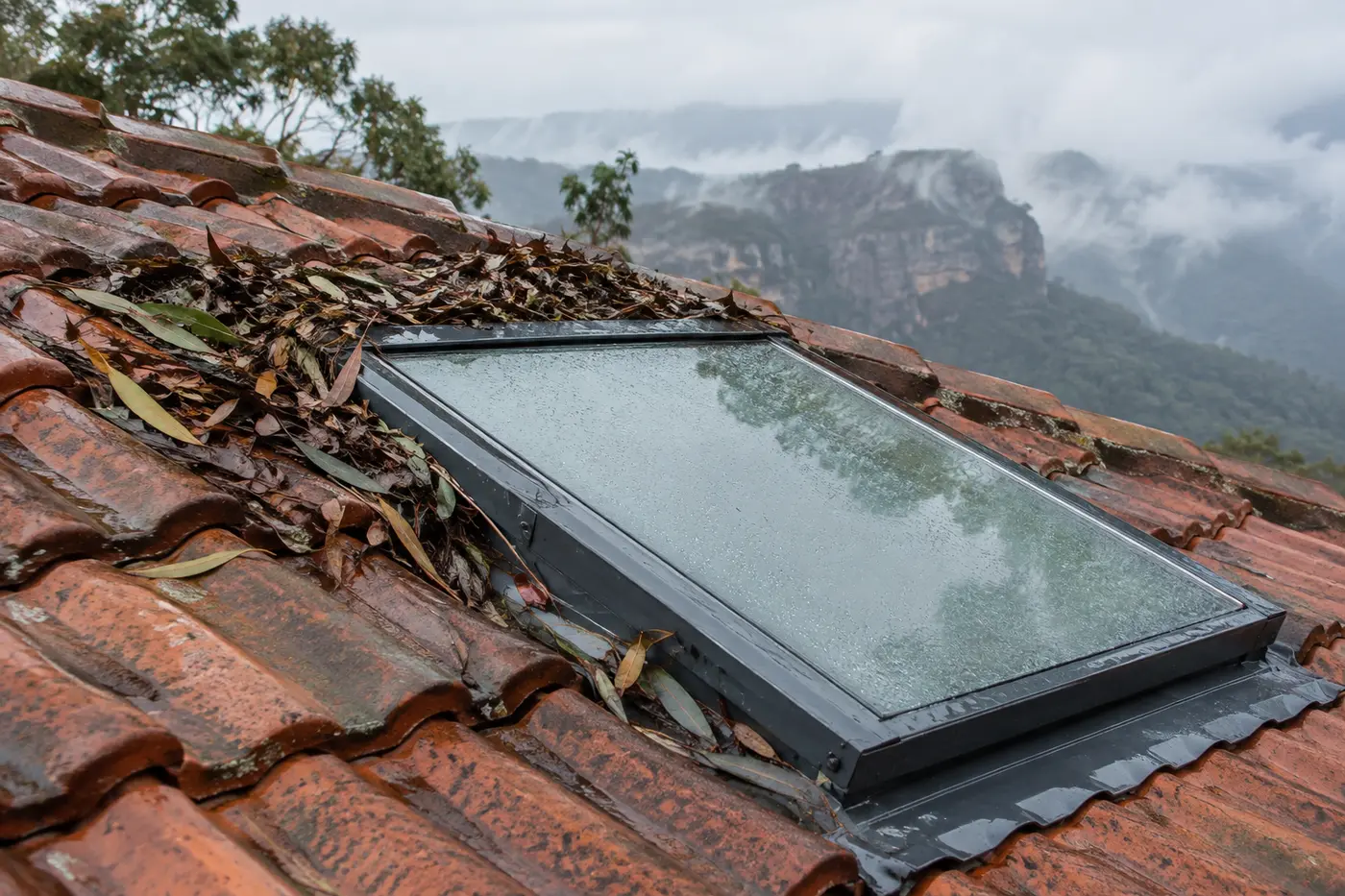
It usually starts with a drip on the kitchen bench. You put a tea towel down, then a bowl, and by the next wet morning you are looking up at the skylight wondering whether the whole thing needs to come out. A leaking skylight is one of the most common leak calls we get across the Blue Mountains, and the good news is that the skylight itself is often not the problem. The water is usually getting in around it, not through it.
Here is how we work out what is going on, what the likely causes are on Mountains roofs, and how we decide between a repair and a new unit.
First, rule out condensation
Before anyone gets on the roof, it is worth asking whether the water is coming from outside at all. A skylight is a hole in your insulation with a thin pane over it. On a cold night the glass or dome gets much colder than the room below, and the warm, damp air from cooking, showers and heaters turns back into water on it. That water then runs down the shaft and drips, which looks exactly like a leak.
The giveaway is timing. Condensation shows up on cold, still mornings, often in winter, often in kitchens and bathrooms, and it can happen when it has not rained for a week. You will usually see fine droplets across the whole inside face of the glass rather than a single wet spot. A real leak follows the weather: it appears during or straight after rain, and it gets worse when the rain is heavy or blowing hard.
Condensation is still worth fixing, because it soaks insulation and stains ceilings just like a leak does. The fix is about moisture and airflow, though, not sealant. If that sounds like your skylight, our guide to damp roof spaces and how ventilation helps is the better place to start.
Where the water appears is a strong clue
If the drip only turns up when it rains, look at where it shows. You can do this from the floor with a torch, without climbing anything.
Water at the top of the shaft, or running down from the upper corners, usually means it is getting in on the roof above the skylight. That points to the flashing at the head of the skylight, or to something further up the roof that is running down and finding the opening. Water at the bottom edge or the lower corners more often means the seals around the glass have failed, or that water is pooling on the uphill side and overflowing. A brown stain partway down the shaft walls, with the glass area dry, can mean water is getting under the tiles nearby and tracking along the framing into the shaft.
None of these is certain, because water travels along battens and rafters before it drips. But noting it down, along with what the weather was doing, saves time when we arrive.
Why skylights leak on Mountains roofs
The skylights we look at tend to fail in a handful of predictable ways.
The flashing has lifted, rusted or was never right
Flashing is the metal skirt that joins the skylight to the roof and turns water back onto the tiles or sheets. It is the most common culprit we find. Sun and frost move it, fixings work loose, and on older installs it was sometimes cut short or pressed into tiles it never quite fitted. Odd tile profiles on older terracotta roofs make this worse, because standard flashing kits do not always sit flat on them. A small lift at one corner can stay dry for years and then let water straight in on the first night of wind-driven rain. Our article on how flashing fails around chimneys and skylights covers this in more detail.
Leaves are damming the uphill side
The uphill edge of a skylight stops anything sliding down the roof. Under eucalypts that means leaves, bark and seed pods pile up there, hold water against the flashing and eventually push it over the top or under the edge. This one surprises people, because the skylight can be in perfect condition and still leak simply because it is buried in debris.
The seals or the dome have perished
Rubber seals around the glass shrink and crack with age and UV. Older plastic dome skylights, common on Mountains homes from the 1980s, go brittle and yellow, and they can craze or split around the fixings. Once a dome has reached that point, resealing it rarely holds for long.
The roof around it is the real problem
Sometimes the skylight just happens to be the lowest opening a leak can find. A cracked tile or a slipped course a metre uphill sends water down the sarking (the membrane under the tiles) until it reaches the cut-out for the skylight. Fix the skylight and the leak simply moves. That is why we check the roof above it, not just the unit.
Sealant over the gap only buys time
The most common thing we undo on a leaking skylight is a thick bead of silicone run around the frame. It looks sealed. Within a season or two the sun breaks the bond, the bead lifts at one end, and it often traps water behind it so the flashing rusts from the back. It also hides the evidence of where the water was actually getting in.
A lasting repair matches what has actually failed. That might mean clearing the debris and refitting the flashing, replacing a section of rusted or poorly fitted flashing, replacing perished seals, or replacing the cracked tiles above. We go through the full range of work, including skylight repairs and new installs, on our skylight and roof inspection service page.
When a new skylight is the better call
Repair makes sense when the unit is sound and the problem is around it. Replacement starts to make sense when the dome is brittle or cracked, the frame is warped, or the skylight has been patched so many times that there is little original sealing left. Old plastic domes can usually be swapped for a modern glass unit without major structural changes, and that also tends to help with the heat and condensation problems older domes are known for.
If your roof is due for a restoration or a re-roof anyway, that is the best time to deal with a tired skylight. The roof is already being worked on, and new flashings can go in with everything else.
What to do until it is fixed
Catch the water with a bucket or towels and move anything valuable out from under it. If water is getting near a downlight or any electrical fitting, switch that circuit off at the switchboard and have an electrician check it before you turn it back on. Please do not go up on the roof yourself. Wet tiles are slippery, the area around a skylight is where you are most likely to put a foot through, and an old dome will not hold your weight.
A photo of the drip, a note of when it started and what the weather was doing, and a quick look for a stain anywhere else on the ceiling nearby are all genuinely useful when we come out.
How we handle a leaking skylight
We inspect on the roof for free, check the skylight, its flashing and the roof above it, and photograph what we find. You get a fixed written quote that separates what needs doing now from what can wait. If water is actively coming in, we can make the area weathertight while the proper repair is scheduled. Our repairs carry a 2-year workmanship warranty, and work done as part of a full restoration or replacement carries 7 years, conditions apply.
If your skylight drips every time a front comes through, or you are not sure whether it is a leak or condensation, book a skylight check with our team or call (02) 4742 0922 and we will come and take a look.