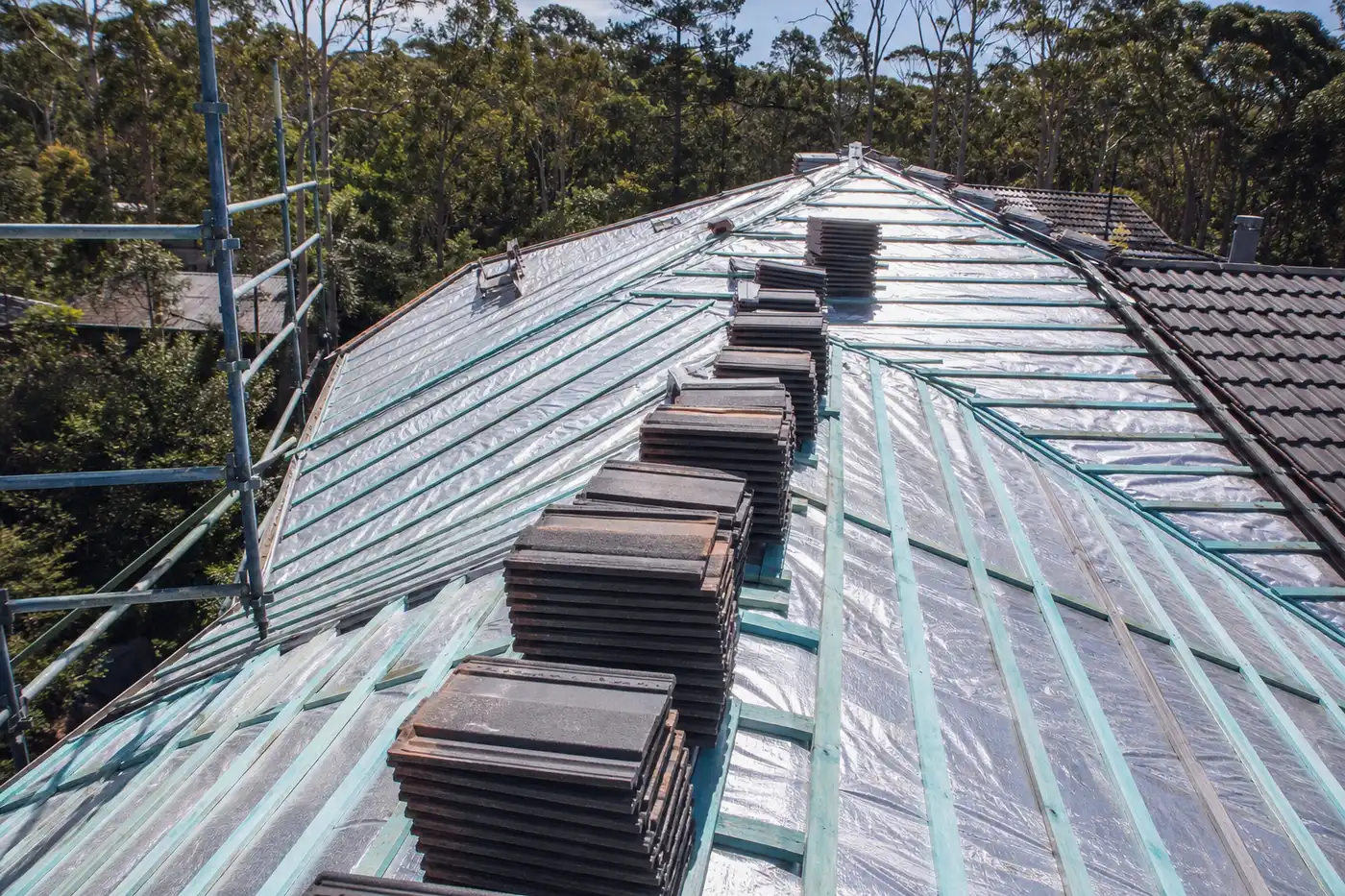
You get the building inspection report back, and buried in it is a line that stops you: no sarking under the roof. Or maybe a roofer quoting your re-roof mentioned it, put it on the quote as a line item, and you nodded along without really knowing what it was. Roof sarking is one of those things that sits out of sight and gets almost no thought until someone points at it. Then you want to know whether it matters, whether you actually need it, and whether your house has a problem without it. The honest answer is that it depends on your roof, and up here it earns its keep more than most people expect.
What sarking actually is, minus the jargon
Sarking is a thin, flexible membrane laid across the rafters before the tiles or metal sheets go on. Think of it as a second skin under the roof covering. The tiles or sheets are the first line of defence and they do most of the work, but they were never meant to be perfectly watertight on their own. A tiled roof sheds water. It does not seal it out. Sarking sits underneath and catches anything that gets past the top layer, then steers it back out to the gutter instead of into your ceiling.
Plenty of older Mountains homes have no sarking at all. The tiles go straight over the battens and the roof space is open to whatever gets through. For a long time that was simply how roofs were built here, so a roof without it is not automatically a fault. It just leaves less margin when something goes wrong up top.
Why it works harder up here
The Blue Mountains throws three things at a roof that make sarking worth more than it would be down on the flat. Wind-driven rain, cold nights, and in a lot of streets, bushland right on the boundary.
Sideways rain and the odd cracked tile
When a southerly drives rain across a ridge line, water gets under tiles that would shrug off ordinary weather. One cracked tile you did not know about is enough. With sarking, a small breach means a damp patch on the membrane and a slow trickle to the gutter. Without it, the same breach drips straight onto your insulation and turns up as a brown stain on the ceiling a few weeks later. If your roof already lets water in when it really comes down, that is a separate problem to fix first, and it helps to understand why a roof leaks in heavy rain before you spend money on anything else.
Cold nights and the condensation nobody sees
The other reason is the cold. In the mid and upper Mountains the nights get properly cold, and a metal roof in particular can drop below the temperature of the air sitting in the roof space. Warm, moist air from inside the house rises, meets that cold underside, and turns back to water. No leak, no rain, just condensation forming under the sheets and dripping onto the insulation. Across a wet winter that quietly soaks batts and framing, and you would never know from inside until something sags or smells musty. The right sarking gives that moisture a path away and keeps it off the ceiling. On a cold-climate roof it is doing real work.
Living on the bush edge
A lot of the Mountains sits hard against bushland. If your block has a bushfire attack level assessed at BAL 12.5 or higher, the building rules call for sarking as part of sealing the roof against ember entry. Whether that applies to your particular property is a question for a BAL assessment or Council mapping, not something to assume either way. But it is one more reason sarking comes up in conversation here far more than it does in a suburb miles from any bush.
When the rules say you have to have it
Sarking is not compulsory on every roof, which is why the advice you read online seems to argue with itself. It comes down to a few specifics. The building code calls for sarking on a tiled roof where the rafter length runs longer than about six metres, because a bigger roof plane catches more wind-driven water. Low-pitch roofs, where water drains slowly and can work its way back under the tiles, generally need it too. And the bushfire rule sits over the top of both of those. If none of the three apply to your place, sarking shifts from a requirement to a sensible option.
That distinction matters most when you are re-roofing, because it changes whether it is your call or the code's. Working out which category a roof falls into is part of our roof inspection and sarking work, and it is the sort of thing better checked on the roof than guessed from the ground.
Can you add it to a roof that is already on?
This is the part people do not love hearing. You cannot slide sarking under an existing roof without taking the covering off first, because it lives between the rafters and the tiles. So sarking gets added when the roof is coming off anyway: a full re-roof, a replacement, or a large section being relaid. Trying to retrofit it to an intact roof means lifting every tile, which is most of the cost of a re-roof for a fraction of the payoff.
That is why the time to think about sarking is when bigger roof work is already on the cards. If your roof is near the end of its life and you are weighing up a restoration against a full replacement, sarking is one of the quiet upgrades that comes cheaply with a re-roof, because the tiles are already off. Done at that point it costs you the membrane and the labour to lay it, not a whole separate job. And when it goes on as part of a restoration or replacement, it sits under the same workmanship warranty as the rest of the work, which for us is seven years on those jobs, conditions apply.
Tile and metal do not want the same thing
On a tiled roof, sarking is mostly that secondary weather barrier, plus ember sealing where a bushfire rating calls for it. On a metal or Colorbond roof the condensation job jumps to the front, because metal gives up heat fast on a cold night and the underside sweats. A metal roof with no way to manage that moisture will drip onto the ceiling below over time. Anti-condensation sarking or a blanket under the sheets is how that gets handled. So if you are choosing between a tile and a metal re-roof, the sarking spec belongs in the conversation, not tacked on at the end.
None of this means every roof in the Mountains needs sarking tomorrow. A sound roof with no sign of damp is fine as it is. The point is to know where your roof stands, so that if the covering ever does come off, you make the call on sarking on purpose rather than by accident.
If you are planning a re-roof, replacing a tired roof, or an inspection has flagged no sarking and you want to know whether it matters for your place, get someone up there to look. We will tell you honestly whether your roof needs it, whether the code requires it, and what makes sense for the way your house handles Mountains weather. Book a free roof inspection and you will get a straight answer rather than a sales pitch.