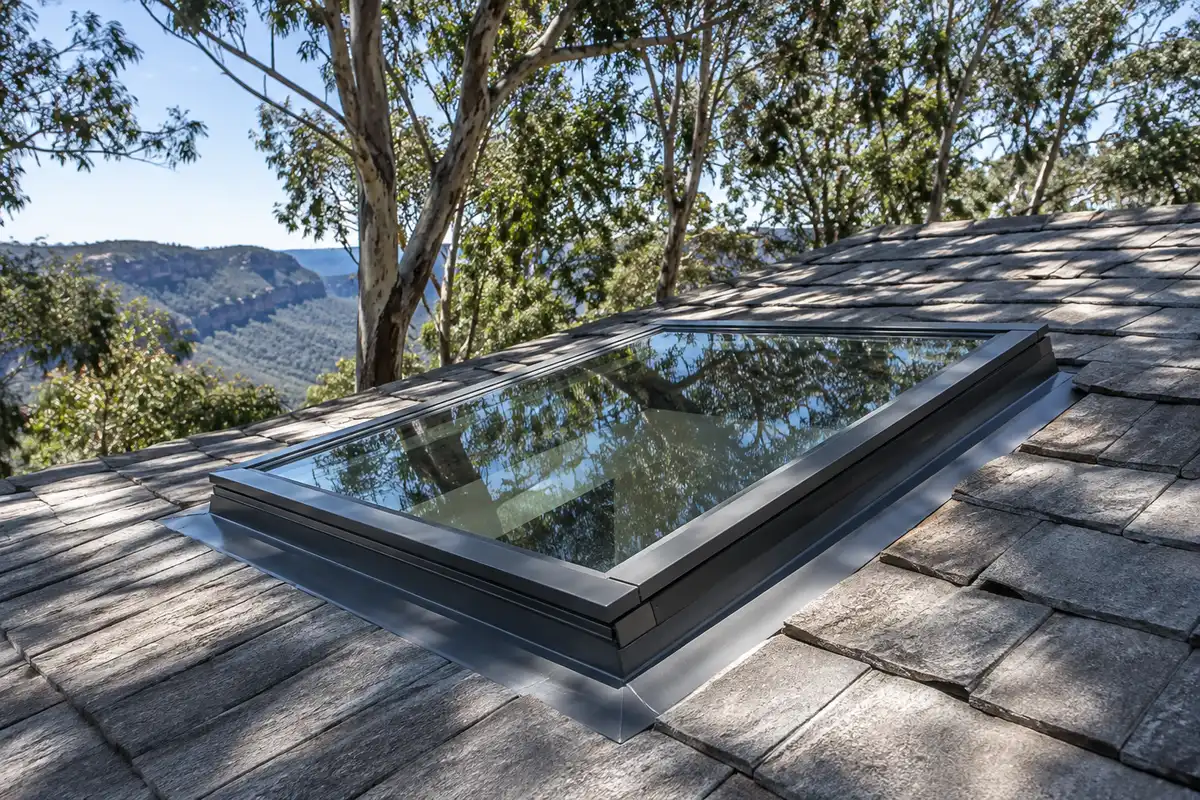
Most of the skylight enquiries we get start the same way. There is a hallway, a kitchen or a bathroom in the middle of the house where the lights go on at lunchtime, because the gums outside block every window. Someone suggests a skylight, and the next question is what it will cost. Look up skylight installation cost online and you get national averages and price tables from other cities, with nothing about your roof.
We are not going to add another average to that pile. Two skylights that look the same from inside can be very different jobs on the roof and in the ceiling space. What we can do is explain what actually moves the price, so you can read a quote properly and know which choices are worth paying for.
The type of skylight is the first big decision
We install three broad kinds into Mountains homes, and they sit at quite different points on the price scale.
Tubular skylights
A tubular skylight is a small dome on the roof with a reflective tube that carries light down to a round diffuser in the ceiling. Because the opening in the roof is small and the tube can bend around obstacles in the roof space, it usually needs the least cutting and framing. It suits hallways, bathrooms, laundries and walk-in robes, anywhere you want daylight but not a view of the sky.
Fixed glass skylights
A fixed skylight is a framed glass window set into the roof, with a lined shaft (a boxed tunnel) running down to a square or rectangular opening in the ceiling. You get more light and a real view of the sky and the trees. You also get more work: a bigger hole in the roof, framing around it, a shaft to build and line, and plastering to finish.
Opening skylights
An opening skylight does everything a fixed one does and also lets hot or steamy air out. Manual versions open with a pole or winder. Motorised versions usually need power run to them, which brings an electrician into the job. They cost more to buy and more to fit, but in a bathroom or a kitchen that fogs up on cold mornings they can earn their keep.
Within each type, size and glazing add to the price. A larger unit means a larger opening and more framing. Better glazing costs more up front, but it helps with summer heat and winter heat loss, which matters in a house that sees both.
Your roof decides how much work happens outside
Metal roofs are generally the more straightforward to work on. The sheet is cut, the skylight goes in, and the flashing is fitted and sealed to the profile of the sheeting.
Tile roofs take more care. Tiles around the opening have to come off, some get cut to fit, and the flashing has to be dressed down onto the tile so water runs over it rather than under. Older terracotta roofs are the trickiest. Their tile profiles are not always standard, so off the shelf flashing kits often do not sit flat, and the flashing has to be shaped to suit. That takes longer, and it is exactly the detail that decides whether the skylight stays dry for decades or starts dripping in its second winter.
Access matters too. A steep pitch, a second storey, or a block that falls away so the back of the house is well off the ground all mean more setup and safety gear. Plenty of homes up here have at least one of those. We cover the full range of skylight work, from new installs to repairs and dome replacements, on our roof inspection, sarking and skylight service page.
The part you never see often decides the price
Between the roof and your ceiling there is a roof space, and that is where many quotes go up or down.
If your ceiling is raked (sloping, following the roof line), the shaft is very short or not needed at all. If you have a flat ceiling with a deep roof space above it, a framed skylight needs a tall shaft built, lined and finished. The deeper and more angled that shaft, the more work it is.
Then there is whatever is already up there. Rafters or trusses (the timber frames holding up the roof) may sit right where the opening needs to go. A rafter can often be trimmed around. A truss is different, because it is engineered as one piece and should not just be cut. That can mean moving the skylight a little, choosing a narrower unit or a tubular one, or more structural work. Wiring, downlights and ducting in the way may need an electrician or other trade to move them first.
Finally, ask who finishes the ceiling. Cutting the opening, fitting the shaft and setting the plaster is one thing. Sanding, painting and making the ceiling look as though the skylight was always there is another, and some quotes leave that part to you.
Swapping an old dome usually costs less than a new opening
A lot of Mountains homes already have a skylight, often a plastic dome from the 1980s that has gone yellow and brittle. Replacing one of those is usually a smaller job than starting from scratch, because the opening and shaft are already there. In most cases an old dome can be replaced with a modern glass unit without major structural change, and the new unit generally handles heat and condensation much better.
The catch is that an old opening sometimes hides old problems. If the timber around it has been wet for years, or the shaft has water stains, that needs fixing before the new unit goes in. If your existing skylight is already leaking, our guide to why skylights leak and when to repair or replace is worth reading before you decide.
Mountains weather is why the flashing deserves the money
The Bureau of Meteorology station at Katoomba sits at 1,017 metres and records mean annual rainfall around 1,411 mm. Add the strong westerlies that push rain sideways across a roof, and any opening that is not properly flashed will find a way to let water in.
Flashing is the metal skirt that joins the skylight to the roof and turns water back out onto the tiles or sheets. It is a small part of the price and the biggest part of whether the job lasts. We fit skylights to the manufacturer's specifications, with underlays suited to the conditions, and we look at what sits uphill of the opening. Under gums, leaves and bark slide down the roof and pile up against the top edge of a skylight. A good installer allows for that rather than leaving a perfect dam for them.
If one quote is noticeably cheaper than the rest, the flashing is the first thing to ask about. A thick bead of silicone around the frame is not a substitute for proper flashing, and it is the most common thing we end up undoing on skylights that leak.
Where it goes matters as much as what it costs
Up here the tree canopy often limits the angles that light can reach your windows, which is why a skylight can make such a difference. It also means placement deserves some thought. A skylight on a north facing roof gets the most direct sun, which is welcome in a Blackheath winter and less so on a hot afternoon in Glenbrook. A south facing one gives softer, steadier light with less heat. Heavy shade from a single big tree can make one side of the roof far better than the other.
Cold mornings bring another issue. A skylight is a gap in your ceiling insulation, and warm damp air from showers and cooking can condense on the cold glass and drip, which looks like a leak. Better glazing, an opening unit in wet rooms and a well ventilated roof space all help. Our article on damp roof spaces and ventilation explains why some Mountains roofs are more prone to this than others.
Check heritage and bushfire rules before you commit
Some parts of the Mountains sit in heritage conservation areas, and visible changes to a roof can be assessed on those properties. Some properties are also mapped as bushfire prone, which can affect what is allowed in new roof openings. Both are property specific. Many homes are neither, but it is worth confirming your property's status with Blue Mountains City Council before you settle on a skylight, particularly one visible from the street.
What a skylight quote should spell out
A price on its own does not tell you much. When you compare quotes, check that each one says:
- The exact skylight type, size and glazing
- How it will be flashed for your roof, tile or metal
- Whether the shaft is built and lined, and how deep it is
- Who does the plastering, sanding and painting
- Any electrical work for motorised units or moving fittings
- Removal and disposal of an old dome, if there is one
If any of those are missing, ask. The difference between two quotes is usually hiding in one of them.
Doing it with other roof work saves a second setup
If your roof is due for a restoration or a re-roof, that is the cheapest and neatest time to add a skylight or replace a tired one. Access is already set up, tiles or sheets are already being worked on, and the new flashing goes in with everything else. Even if a full restoration is not on the cards, it makes sense to have someone look over the rest of the roof while they are up there, so you are not cutting a new opening into a roof that needs other work.
Get a price for your roof, not an average
The only way to turn all of this into a real figure is to see your roof, the roof space and the room you want to light. We inspect and quote for free, and we will tell you honestly if a tubular unit would do the job for less than a framed one. To get started, book a free skylight assessment or call (02) 4742 0922.