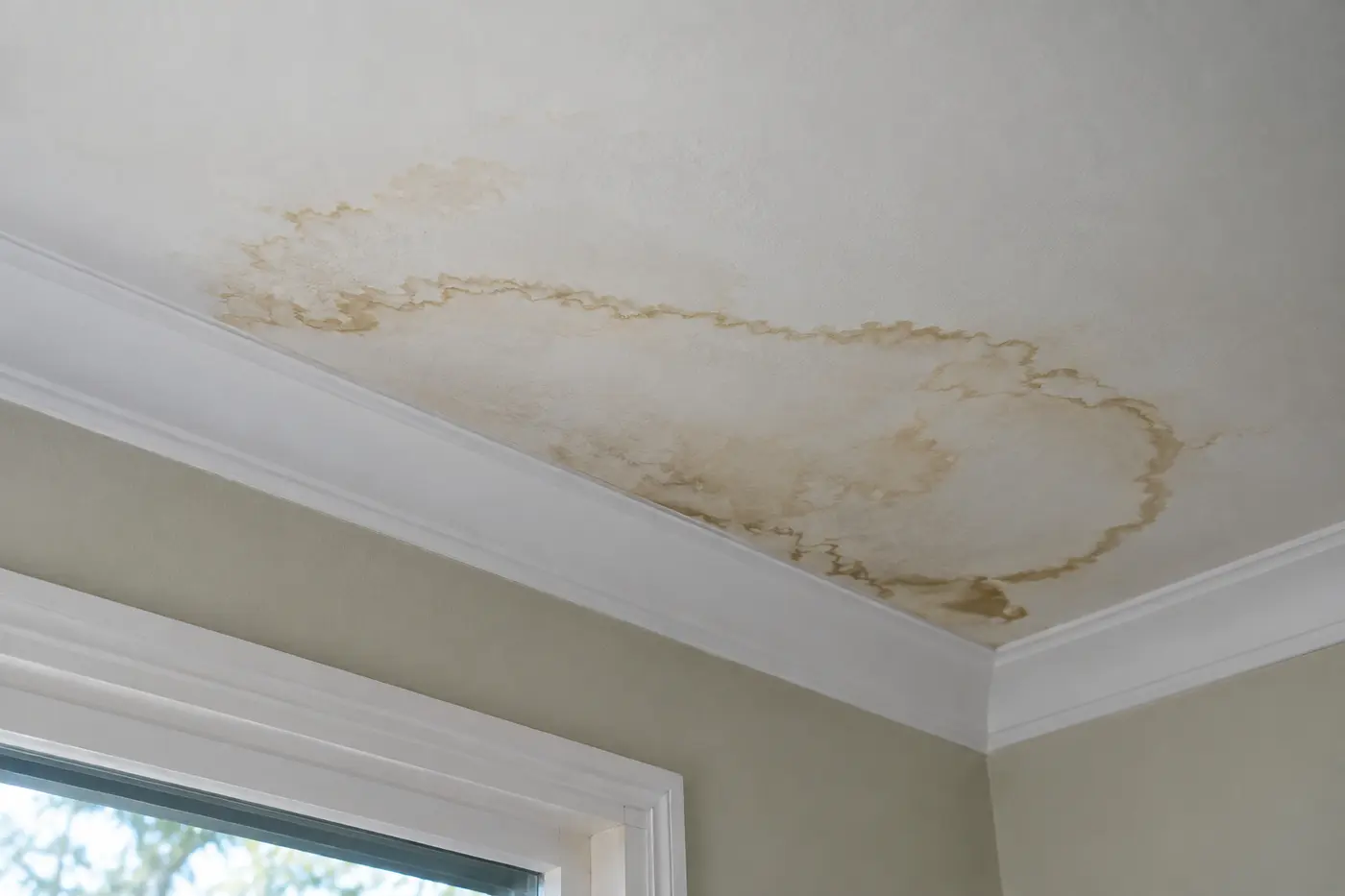
Most people find it by accident. You are lying on the couch, or switching off the bedroom light, and there it is: a pale brown ring on the ceiling that you are fairly sure was not there last month. Nothing is dripping. The carpet is dry. So is it the roof, a pipe, or something else entirely? A water stain on the ceiling is one of the most common reasons people ring us, and a fair share of the time the honest answer is that it is not the roof at all.
That matters, because calling the wrong trade costs you a callout and a few more weeks of water soaking into the ceiling. Here is how we read a stain before anyone climbs a ladder, and what each pattern usually means.
The timing of the stain is your best clue
Start with one question. Does it get worse after rain, or does it change regardless of the weather? A stain that darkens or spreads in the day or two after a downpour, then slowly dries back, is almost always water coming through the roof. One that grows during a dry fortnight has nothing to do with the weather, and that points to plumbing.
A simple way to answer it is to trace the edge of the stain lightly in pencil, if you can reach it safely from a stable step ladder. Check it again after the next decent rain, and again after a dry week. If the mark has crept past your line, you know it is still active and you know roughly what sets it off. Brown tide lines in rings, one inside the other, tell a similar story: that patch has got wet and dried out more than once.
Where the stain sits narrows it down further
Location tells you a lot. These are the patterns we see over and over:
- Directly below an upstairs bathroom, laundry or toilet: plumbing, nearly every time
- On the ground floor ceiling of a two storey house, with no balcony above: same story, since there is no roof overhead
- Near an outside wall, along the cornice or in a corner: often an overflowing gutter, a valley or flashing
- Around a chimney breast, skylight or flue: flashing, until proven otherwise
- Lots of small grey or black spots across a cold ceiling, rather than one ring: usually condensation and mould
None of these is a certainty, but they tell you who to ring first.
Stains that follow the rain usually start well away from the mark
If the timing points to the roof, do not assume the hole is directly overhead. Water that gets in at a cracked ridge cap, a rusted valley or a lifted flashing tends to run along the sarking (the membrane under the tiles) or down a rafter before it drops onto the ceiling. We regularly find the entry point a few metres from the stain. Our guide to why roofs leak in a real downpour goes through the usual entry points in more detail.
On the tile roofs common up here, cracked ridge mortar, blocked or rusted valleys and perished flashing account for most of what we find. And the upper Mountains is wet. The Bureau of Meteorology station at Katoomba records mean annual rainfall of around 1,411 mm, so a small fault gets plenty of chances to show itself.
Finding the real source is the part that takes experience. We start at the stain, go into the roof space to follow the water marks on the timber, then get up on the roof to confirm where it starts, rather than smearing sealant on the nearest crack and hoping. If that sounds like where you are, here is how we go about finding the true source of a roof leak and fixing it properly.
If it is plumbing, you need a plumber, not a roofer
We would rather tell you this up front than charge you to find out. A stain under a bathroom that appears whether or not it has rained is most likely a leaking shower base, failed waterproofing, a weeping pipe joint or a toilet seal. Some homes also have water pipes or a hot water unit in the roof space, and a slow drip from one of those looks a lot like a roof leak from below. A licensed plumber can pressure test the pipes and trace hidden leaks. That is their trade, not ours.
Ducted air conditioning is the other one that fools people. The indoor unit usually sits in the roof space and drains its condensate through a small pipe and tray. If that drain blocks or the tray overflows, you get a stain in summer, in dry weather, often near the unit or a ceiling vent. That is a job for whoever services your air conditioning.
A stain with no leak behind it is often condensation
This one surprises people. Warm, damp air from showers, cooking and clothes drying inside rises into the roof space. On a cold Mountains night it meets the underside of the roof, which can be far colder than the room below, and turns back into water. On a metal roof without sarking or a good insulation blanket, those droplets can drip straight onto the ceiling. In a tile roof space it tends to show up as damp insulation and mould spotting instead.
The signs are different from a leak: scattered grey marks rather than one ring, worse in winter and on cold mornings, and often in bathrooms and bedrooms. A tube of sealant will not touch it. Better airflow and less moisture will, and our piece on how ventilation dries out a damp roof space explains the options.
An old, dry stain can still be worth a look
Plenty of stains are history. A leak was fixed years ago, perhaps before you bought the place, and nobody got around to repainting. If the pencil line has not moved through a few rounds of heavy rain and the plasterboard feels firm, it may well be just a cosmetic mark. The catch is that dry weather hides active leaks, so a stain that stayed put through a dry spell has not passed the test yet. A roof inspection settles it either way.
Signs a ceiling stain needs attention this week
Some stains can wait for a dry day and a booked inspection. These cannot:
- The ceiling is sagging, bulging or soft
- The stain is near a light fitting, downlight or ceiling fan
- It is spreading fast, or water is dripping
- There is a musty smell or visible mould on it
- Paint is bubbling or plaster is crumbling
Wet plasterboard is heavy and can give way without much warning, so keep people and pets out from under a bulging section. If water is anywhere near electrics, switch that circuit off at the switchboard and have an electrician check it before you turn it back on.
Paint over it last, not first
It is tempting to roll some ceiling paint over the mark and forget about it. Hold off. Paint hides the one piece of evidence that tells you whether the leak has actually stopped, and ordinary ceiling paint usually lets the brown mark bleed straight back through anyway. The right order is to fix the source, let the ceiling dry out completely, then deal with the mark. A painter will normally seal it with a stain blocking primer before the top coat. If the plasterboard has gone soft or sagged, that section usually needs to be cut out and replaced rather than painted.
If the stain on your ceiling seems to follow the rain, or you just cannot tell what is behind it, we give free inspections and quotes right across the Blue Mountains, and our roof repairs carry a 2-year workmanship warranty, conditions apply. We will tell you straight whether it is the roof, and if it is not, we will say so and point you to the right trade. Have a local roofer check that ceiling stain before the next big storm comes through.